E-invoicing is no longer just a finance topic. In Europe, it is becoming part of a much bigger shift toward standardised digital trade.
For years, businesses have talked about digital transformation as if it were mainly about replacing paper with screens. But when it comes to invoicing, that is only half the story. Sending a PDF by email may feel digital, but it still depends on manual work. Someone has to open it, read it, check it, enter the data, and hope nothing gets lost or mistyped along the way.
True e-invoicing is different. It is the exchange of invoice data in a structured format that systems can read automatically. That means an invoice can move directly from one business system into another with minimal human involvement. In practical terms, that is what makes it faster, more accurate and more scalable than traditional invoicing workflows.
And in Europe, that shift is being accelerated by one thing above all: standardisation.
What e-invoicing actually means
A lot of businesses still confuse digital invoicing with e-invoicing.
A PDF invoice is digital in the sense that it is not printed, but it is still essentially a picture of a document. It sits in an inbox and usually waits for a human to handle it. E-invoicing, by contrast, uses structured formats such as XML and common frameworks such as Peppol, so invoice data can be created, validated, transmitted and received automatically between systems.
That distinction matters. Because the real value of e-invoicing is not just that it removes paper. It is that it removes friction.
When invoice data is structured correctly from the start, businesses reduce manual entry, lower the risk of errors, speed up processing and create a better foundation for compliance and reporting. The European Commission’s work on e-invoicing has consistently focused on interoperability, efficiency and reducing barriers created by fragmented national and technical requirements.
Why standardisation is the real story
The rise of e-invoicing in Europe is not happening in isolation. It is happening because Europe has spent years building a more standardised framework for how business documents should be exchanged.
A major milestone was Directive 2014/55/EU on electronic invoicing in public procurement. That directive created the basis for a common European approach and led to the development of the European e-invoicing standard, EN 16931. By April 2020, public authorities across the EU had to be able to receive and process compliant electronic invoices for contracts above the EU procurement thresholds.
That was important for two reasons.
First, it gave Europe a common semantic standard. Instead of every market, buyer or platform using completely different invoice requirements, EN 16931 created a shared structure for core invoice data. Second, it pushed the market toward interoperability. Once invoice content becomes standardised, system-to-system exchange becomes much easier to scale across borders.
This is exactly where the EDI perspective matters.
EDI has always been about standardised, machine-readable business communication. Purchase orders, invoices, despatch advice and other commercial documents only work efficiently at scale when both sides agree on format, syntax and process. In that sense, the rise of e-invoicing is not a departure from EDI. It is an extension of the same logic. Europe is moving further toward a business environment where structured data exchange is no longer optional or limited to a few large trading relationships. It is becoming the norm.
Peppol and the move toward interoperability
No conversation about European e-invoicing standardisation is complete without Peppol.
Peppol is both a document framework and a governed network that allows organisations to exchange standardised electronic documents through accredited service providers. OpenPeppol describes it as a way to enable fast, secure and borderless trade by standardising how information is structured and exchanged.
That matters because standardisation is not only about the invoice format itself. It is also about how the document moves. A standard file with no reliable delivery model still creates friction. A network with no common document rules does the same. Peppol helps solve both sides of that problem, which is why it has become such a central part of the European e-invoicing conversation.
For businesses already working with EDI, this feels familiar. The value is not in one isolated message. The value is in having a trusted, repeatable structure for how documents are exchanged across the order-to-cash cycle.
ViDA is raising the stakes
Standardisation in Europe is also moving from public procurement into broader tax and compliance infrastructure.
The VAT in the Digital Age package, adopted on 11 March 2025, sets out a gradual rollout of new digital VAT rules through January 2035. One of its biggest implications is digital reporting for cross-border B2B trade based on e-invoicing. From 1 July 2030, Digital Reporting Requirements will apply to cross-border B2B transactions, and by 1 January 2035, Member States with domestic real-time digital reporting obligations must align those systems with EU standards. The Commission has described e-invoicing as the default basis for this new reporting model.
That changes the conversation.
E-invoicing is no longer just about process improvement inside the finance function. It is increasingly tied to how businesses document transactions, meet reporting obligations and stay aligned with the direction of European regulation. The more Europe moves toward standardised digital reporting, the more valuable structured document exchange becomes.
What this means for businesses
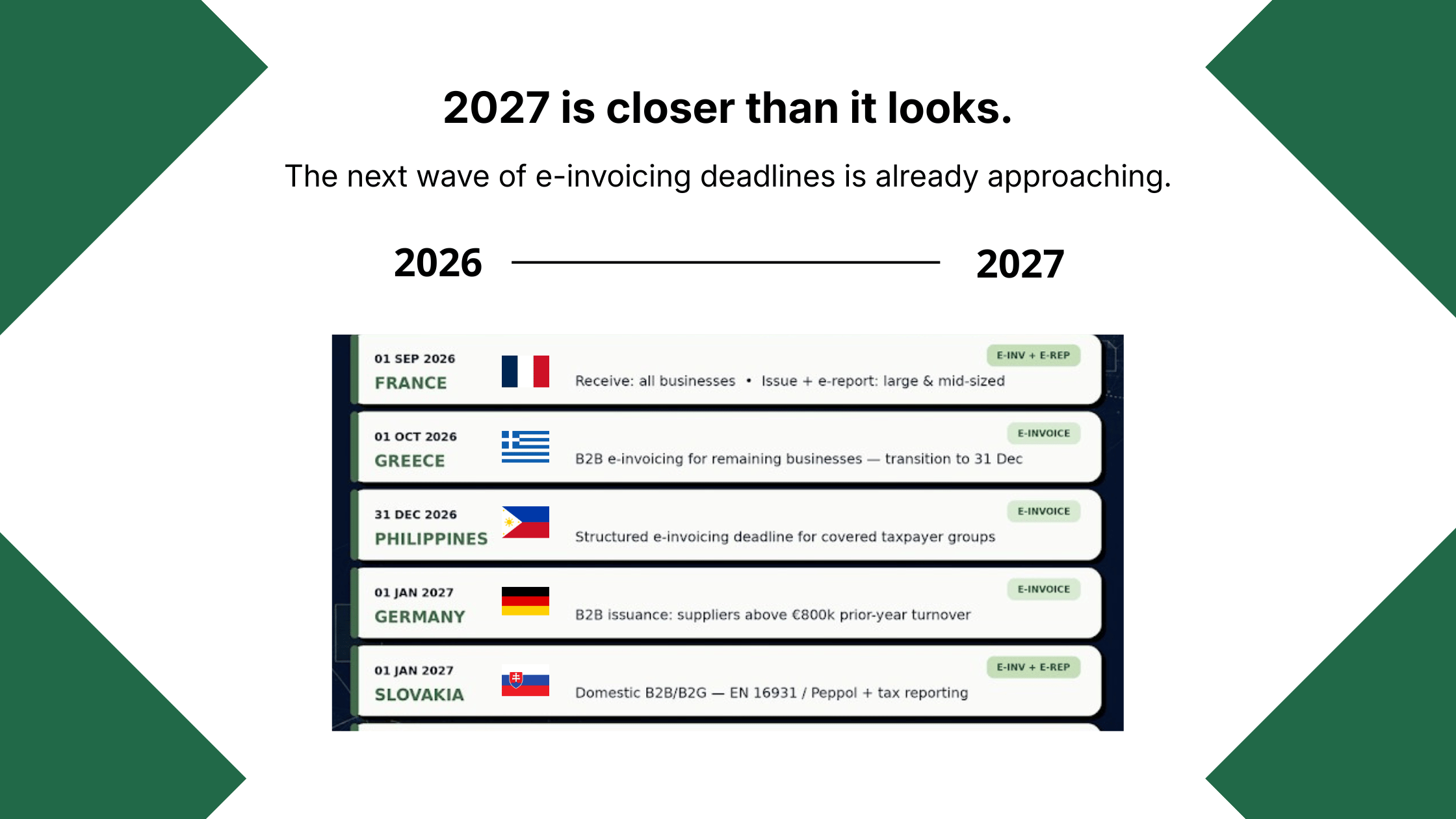
For businesses, the takeaway is clear. The question is no longer whether digital invoicing matters. The question is how prepared your systems are for a more standardised environment.
Companies that still depend on PDFs, email-heavy approval flows and manual posting are not just dealing with inefficiency. They are also building on workflows that do not fit the direction Europe is moving in. As e-invoicing requirements expand and more markets align around common models, businesses need invoicing processes that are structured, connected and ready to integrate with wider EDI flows.
This is why e-invoicing should not be treated as a one-off compliance box. It should be seen as part of a broader digital trade strategy.
If you already exchange orders and other commercial messages through EDI, adding e-invoicing is the natural next step. It helps connect procurement, fulfilment, billing and reporting in one more consistent flow. And if you are only now starting to digitise invoicing, the smartest move is to do it in a way that supports long-term interoperability rather than another isolated format or workaround.
Standardisation is what turns e-invoicing into infrastructure
The real rise of e-invoicing in Europe is not only about automation. It is about alignment.
Europe is steadily building a more common framework for how invoices are structured, transmitted and validated. EN 16931 created a shared standard. Peppol has strengthened practical interoperability. ViDA is pushing structured digital reporting further into the mainstream. Together, these developments are moving invoicing away from fragmented local workflows and closer to a standardised digital infrastructure for trade.
And that is why the topic belongs firmly in the EDI conversation.
Because when invoicing becomes structured, interoperable and system-to-system, it stops being just an accounting task. It becomes part of the larger architecture of digital business.


.png?width=2240&height=1260&name=Greeces%20e-invoicing%20deadline%20is%20closer%20than%20you%20think%20-%20blog%20post%20(1).png)