
COMPLIANCE
E-INVOICING
INTEGRATION
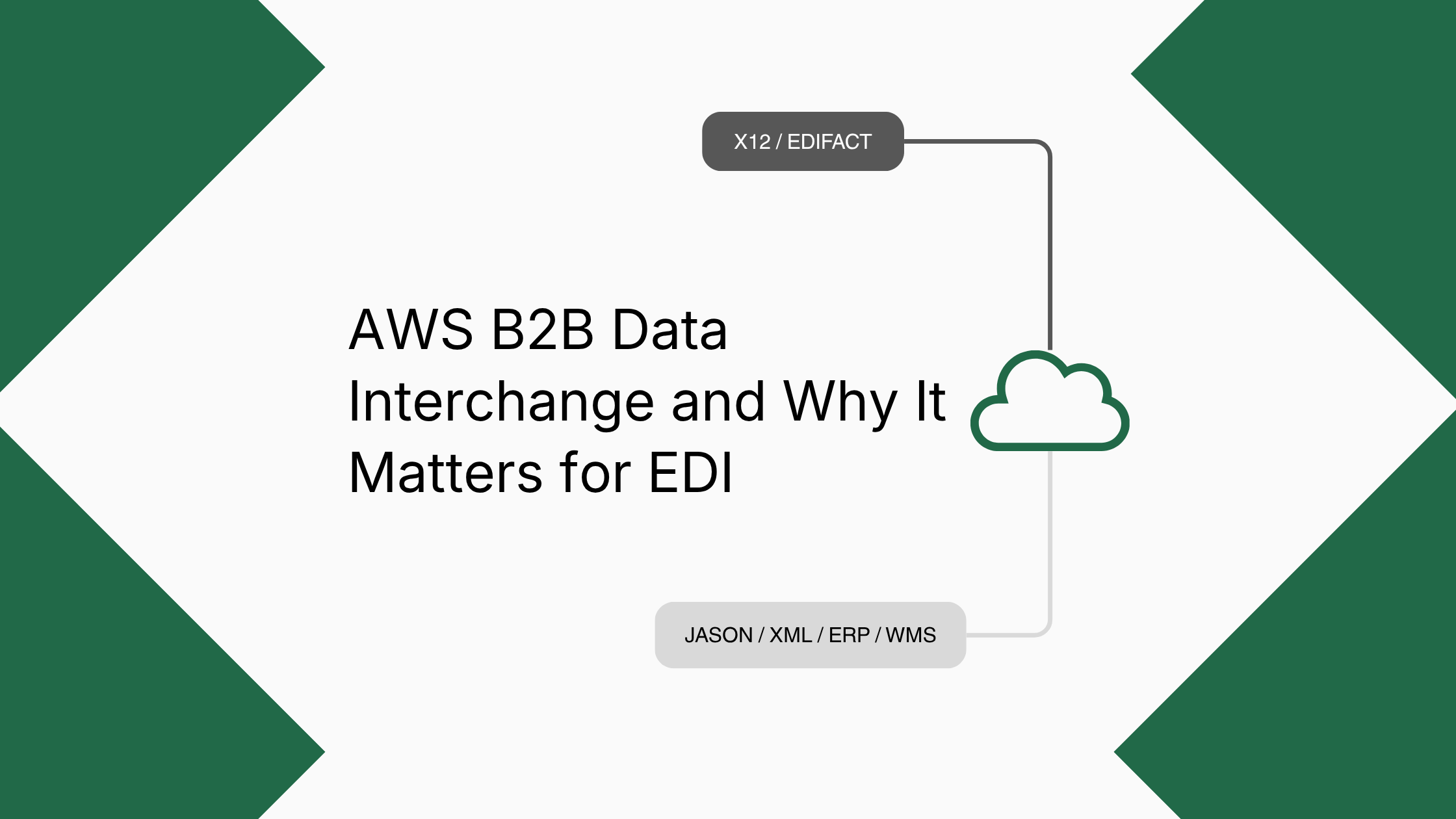

As more businesses modernise their application landscape, one challenge keeps coming back: how do you connect modern cloud systems with the EDI formats that many customers, suppliers, and logistics partners still depend on?
That is where AWS B2B Data Interchange enters the conversation.
At a high level, AWS B2B Data Interchange is a managed AWS service designed to transform and generate EDI documents between traditional business document formats and modern data formats such as JSON and XML. According to AWS, the service is built to reduce the time, complexity, and cost involved in exchanging business documents across organisations.
EDI is still a critical part of digital trade.
Orders, invoices, shipping messages, acknowledgements, and other business documents continue to move between trading partners in standardised formats such as X12, EDIFACT, HL7v2, etc.
The problem is that many internal systems are no longer built around those formats. ERP, WMS, finance, and analytics platforms often work with JSON, XML, APIs, and cloud-native workflows instead. AWS positions B2B Data Interchange as the layer that helps bridge that gap.
The service is built around a few key components.
A profile represents your business, including contact and logging details. A transformer defines how data should be converted between EDI and JSON or XML. A trading capability connects the transformer to specific input and output locations in Amazon S3, and a partnership represents the relationship with a trading partner and the configuration needed to exchange documents correctly.
In simple terms, the workflow looks like this:
Your business places an inbound or outbound file in Amazon S3. AWS B2B Data Interchange detects it, processes it using the configured transformer, and writes the result back to the defined output location. AWS also states that transformation activity and status updates can be logged in CloudWatch and emitted to Amazon EventBridge.
One of the clearest examples is outbound EDI generation.
AWS describes a workflow where a procurement system creates a purchase order in JSON, uploads it to Amazon S3, and AWS B2B Data Interchange converts it into an X12 EDI document for sending to a supplier. On the inbound side, the same logic can work in reverse, transforming incoming EDI into JSON or XML so downstream systems can process it more easily.
This is an important point for businesses already working with EDI. The value is not only document conversion. It is the ability to place EDI into a more modern and event-driven cloud architecture without losing the standardised structure that trading partners require.
AWS B2B Data Interchange does not sit alone.
AWS documents describe how it can work alongside AWS Transfer Family, which supports protocols such as SFTP and AS2 for receiving or sending files to trading partners. In that model, AWS B2B Data Interchange handles transformation, while Transfer Family supports the secure exchange layer between organisations.
That makes the service relevant for businesses that want to modernise their EDI architecture while keeping partner communication reliable and structured.
This is where the technology conversation becomes a business conversation.
A managed AWS service can reduce infrastructure overhead, but it still needs to be designed around real partner requirements, mappings, document flows, onboarding processes, and downstream integrations.
That is where iEDI can support the journey.
For example, an enterprise may use AWS B2B Data Interchange as the technical foundation, while iEDI helps with:
AWS B2B Data Interchange is relevant because it reflects a broader shift in EDI.
Businesses are not moving away from structured B2B document exchange. They are moving away from overly rigid and isolated legacy setups. The goal is increasingly to connect EDI to cloud systems, modern data models, and more flexible workflows.
For companies that want to modernise EDI without abandoning standards, AWS B2B Data Interchange is a technology worth understanding.
And for companies that want to make that transition work in practice, the real value comes from combining the platform with the right EDI expertise. You can learn more about us here.
.png?width=2240&height=1260&name=Greeces%20e-invoicing%20deadline%20is%20closer%20than%20you%20think%20-%20blog%20post%20(1).png)