Romania's e-invoicing story has moved quickly.
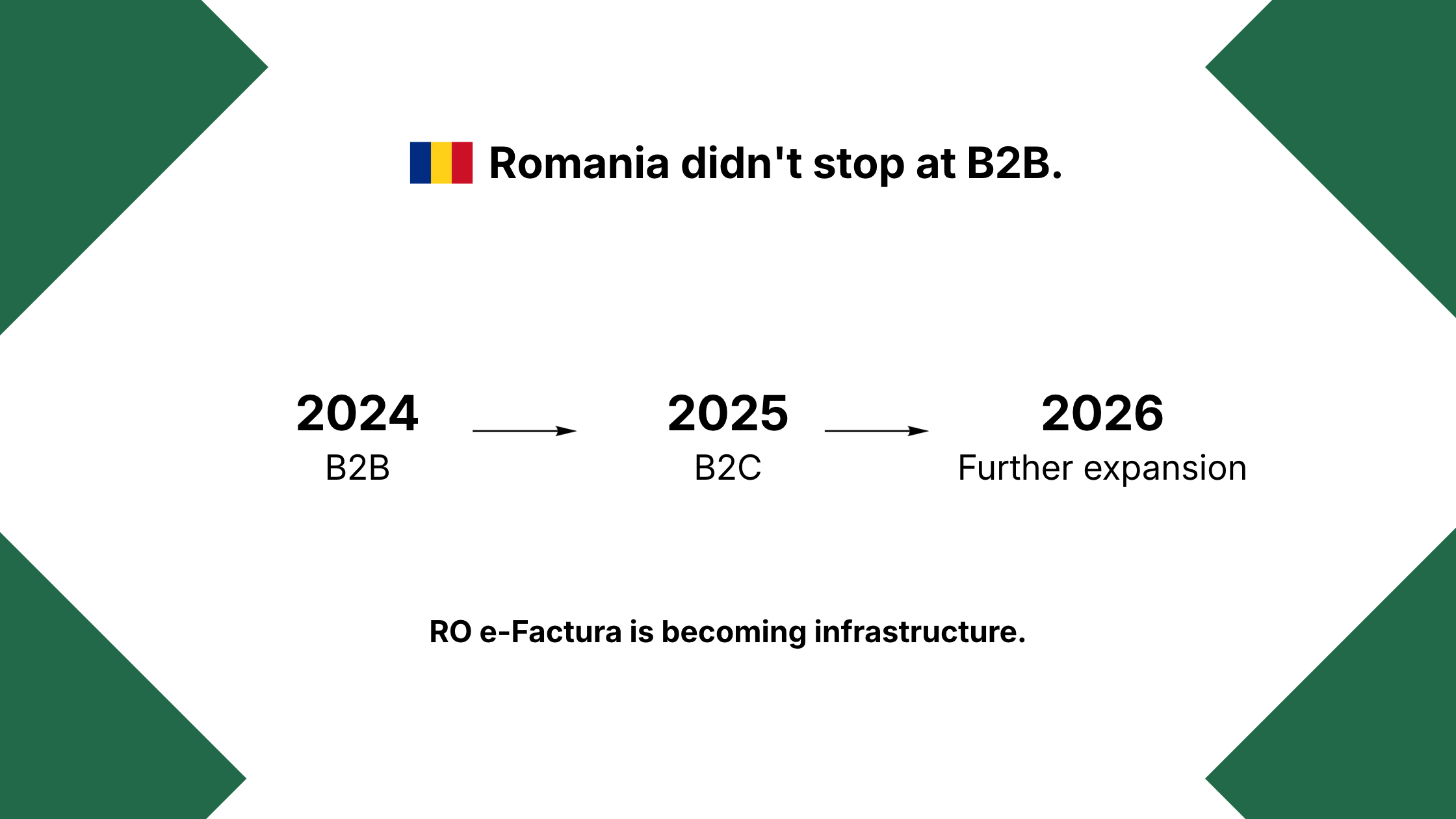
At the beginning of 2024, mandatory RO e-Factura reporting arrived for domestic B2B transactions.
That alone represented a major change in how Romanian businesses handled invoices, but Romania didn't stop there.
The framework has since expanded further, including B2C invoices, while additional changes in 2026 have continued to bring more taxpayers into the system. Anaf
The result is that RO e-Factura increasingly looks like more than a B2B invoicing mandate. It's becoming part of Romania's wider digital tax infrastructure.
A central system for invoice data
RO e-Factura is Romania's national electronic invoicing system, operated through the country's tax administration.
Rather than an invoice simply travelling directly from one business to another, structured invoice information is transmitted through the national system. The technical distinction matters.
ANAF's own invoice-generation tools produce invoices in XML using UBL, and Romania's implementation is built around structured electronic invoice data. Anaf
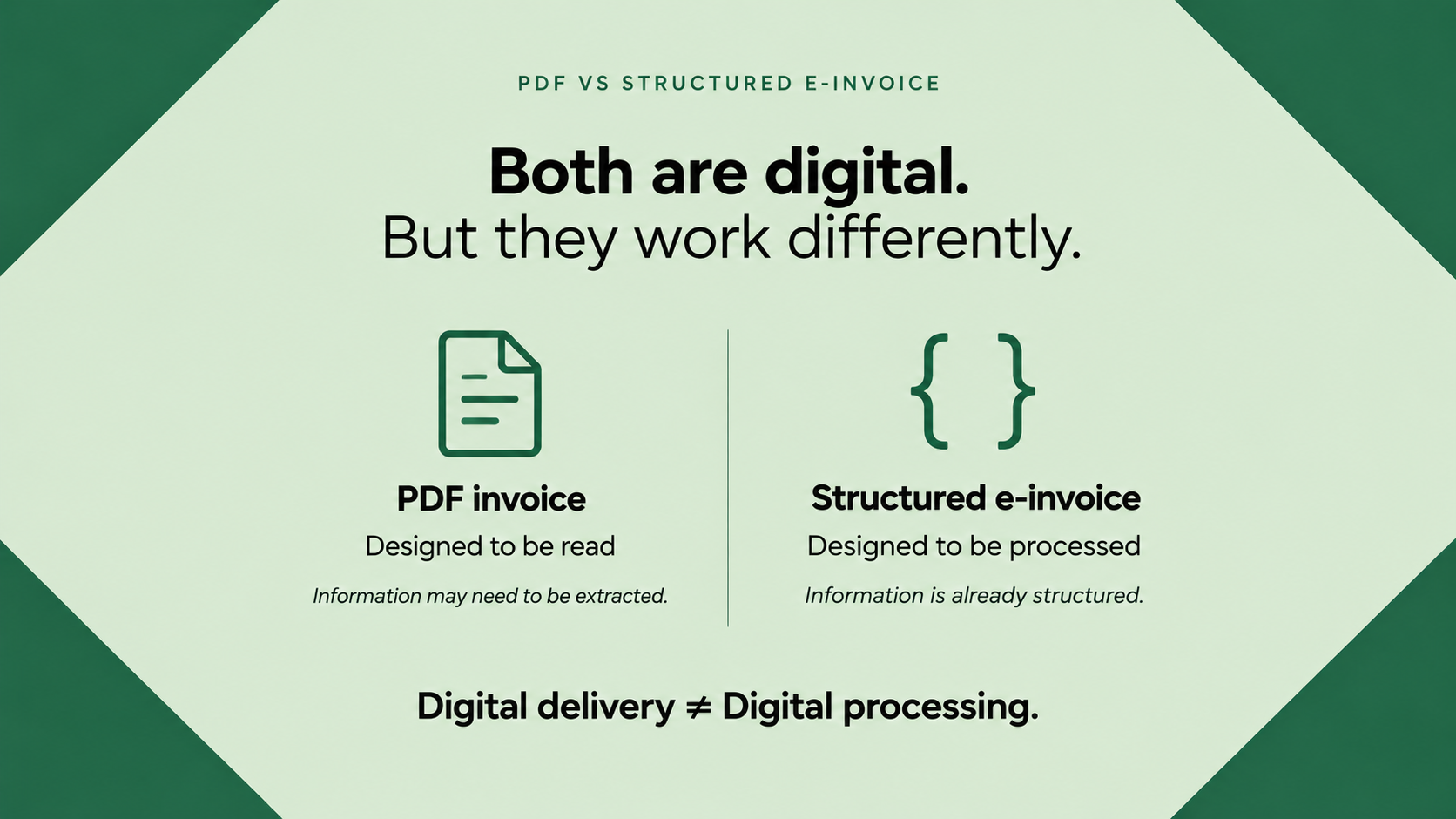
So, as we've seen in other markets, an invoice being digital isn't necessarily enough. The objective is data that systems can process electronically.
That makes ERP integration, invoice mapping, and data quality part of the e-invoicing discussion.
B2B was only one step
Romania's nationwide B2B transition began in 2024.
From 1 January 2024, RO e-Factura became mandatory for domestic B2B transactions, initially with a reporting phase before the system became the required channel for applicable invoices. Anaf
But the scope didn't remain limited to business-to-business invoicing.
From 1 January 2025, Romania also brought B2C invoices into mandatory RO e-Factura reporting, including simplified invoices subject to specified exceptions. Anaf
That's an important development because it changes the scale of the system. A B2B mandate digitalises one part of commercial invoicing, but bringing B2C invoice information into the same infrastructure pushes the system further towards becoming a broad source of transaction data for the tax administration.
And the system is still evolving
Even after those major milestones, Romania's e-invoicing framework hasn't sat idle.
Changes introduced in 2026 continued to adjust who needs to use RO e-Factura and how businesses and professionals interact with the mandatory register.
For example, suppliers and service providers identified for tax purposes through a Romanian personal identification number received a temporary exemption until 1 June 2026, after which affected operators were required to enter the mandatory RO e-Factura framework. Anaf
ANAF also published further legislative guidance on RO e-Factura following changes introduced by Law 88/2026. Anaf
That's worth highlighting because e-invoicing projects don't necessarily end when the headline mandate goes live. The regulatory perimeter can continue to change.
Romania is taking a tax-driven approach
This also gives us another useful comparison with the countries we've covered so far.
Norway is moving from widespread voluntary e-invoicing towards mandatory structured exchange and broader digital bookkeeping.
Sweden is investigating whether domestic B2B e-invoicing and digital reporting should become mandatory.
Poland routes structured invoices through KSeF.
Romania has developed RO e-Factura as a national tax-administration infrastructure, progressively expanding the transactions and taxpayers that interact with it.
The direction may broadly be the same – structured invoice data – but the architecture and purpose can differ significantly.
And that's increasingly important for international companies.
One e-invoicing strategy isn't enough
A company operating across Europe might reasonably decide that it needs to “be ready for e-invoicing”, but what does that actually mean?
In one market, it may mean connecting through Peppol. In another, invoices need to interact with a central government platform.
Elsewhere, invoice data may also need to support separate digital reporting requirements.
Romania is a good example of why international e-invoicing therefore needs to be treated as an integration problem, not simply a document-format problem.
The business systems generating the invoice may remain the same. What changes from country to country is where that data needs to go, in what structure, and under what rules.
RO e-Factura is becoming infrastructure
Perhaps the most interesting thing about Romania today is that the discussion has moved beyond whether e-invoicing will become mandatory. That question has already been answered.
The more interesting question is what happens when a national e-invoicing system progressively expands across different parts of the economy.
Romania started with specific use cases before moving into broad domestic B2B requirements.
Then came B2C reporting.
And further changes continued in 2026.
That progression tells us something about the wider direction of e-invoicing.
The mandate may be the beginning of the story, not the end.
At iEDI, we help businesses connect ERP and business systems to EDI, Peppol, and country-specific e-invoicing frameworks, allowing structured business documents to move between different systems, partners and markets.
Romania didn't simply introduce mandatory e-invoicing. It's turning structured invoice data into national infrastructure.