Almost every business has one: a spreadsheet that's somehow become essential.
Nobody designed it. Nobody officially owns it. Yet everyone depends on it.
It may contain product mappings, order statuses, customer references, invoice reconciliations, or shipment tracking.
At first glance, it looks harmless, but it often tells a much bigger story.
Spreadsheets are rarely the problem
Excel itself isn't the issue; the spreadsheet exists because it solves a problem that the business systems don't.
Perhaps two systems don't communicate, or perhaps supplier data arrives in different formats.
Perhaps someone once built a manual workaround "just until the integration is ready." But years later, that temporary solution still exists.
People become the integration
Eventually, the spreadsheet becomes part of the process.
Someone downloads information.
Someone updates formulas.
Someone emails the latest version.
Someone manually copies information into another system. At that point, the business isn't integrated - the people are.
The hidden costs
The spreadsheet itself is free. The process around, however, isn't.
Hidden costs include:
- Manual administration
- Duplicated work
- Inconsistent information
- Version control issues
- Dependency on individual employees
- Slower onboarding of new colleagues
These costs rarely appear in financial reports, but they affect productivity every day.
Growth exposes the weakness
A manual workaround might function perfectly at low volumes. But as order numbers increase, so does complexity.
Suddenly, the spreadsheet becomes difficult to maintain and understand as well as impossible to scale
Businesses often discover this during ERP upgrades, acquisitions, or periods of rapid growth.
Modern integration removes hidden work
Structured EDI reduces the need for manual workarounds by allowing systems to exchange information directly.
Instead of people acting as intermediaries, documents move automatically between applications.
The result isn't simply fewer spreadsheets. It's more reliable business processes.
Final thoughts
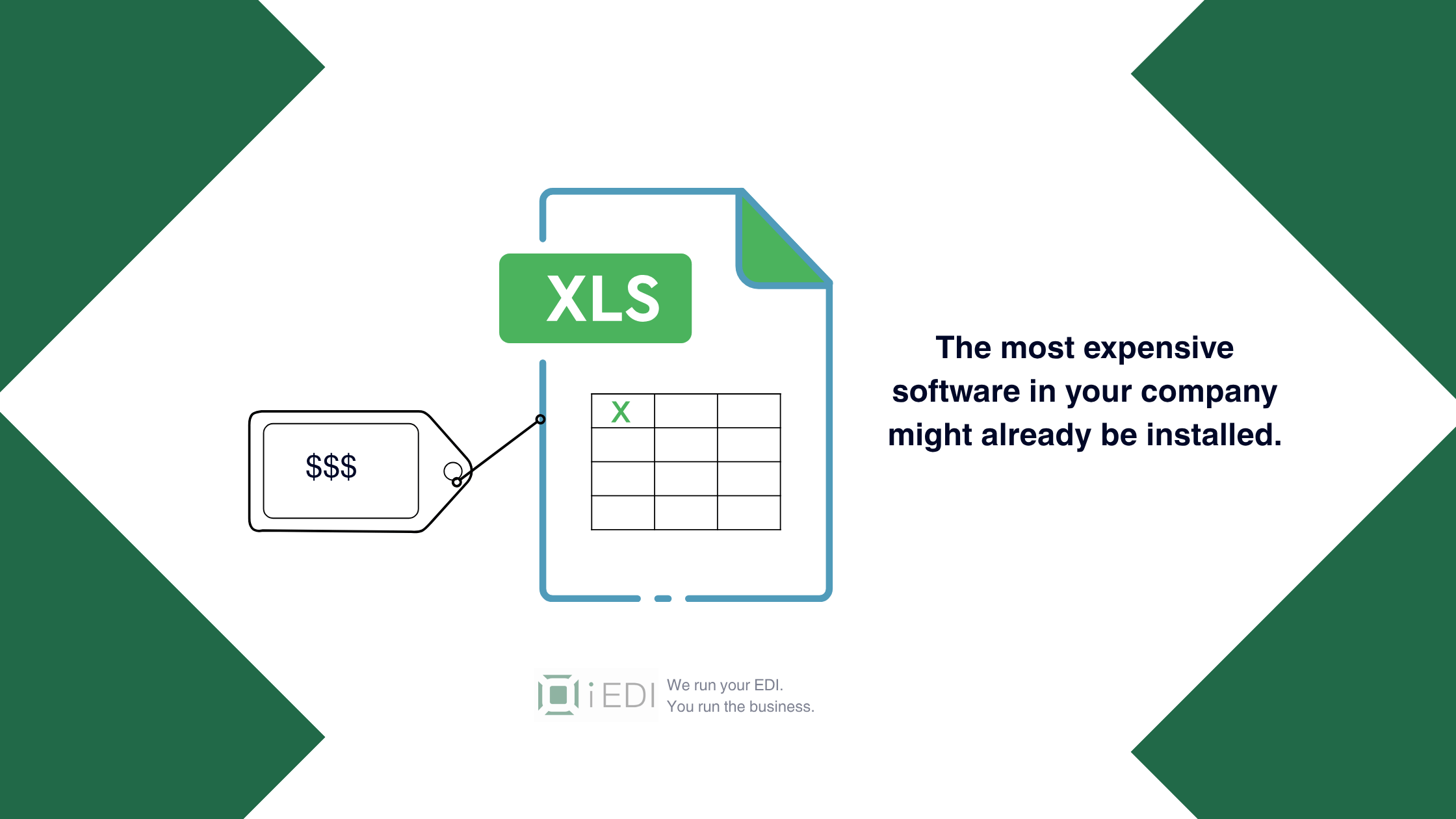
The most expensive software in your organisation may not be your ERP.
It may be the spreadsheet quietly holding everything together. Not because spreadsheets are bad, but because they often reveal where automation hasn't reached yet.
If your business depends on spreadsheets to connect systems, it may be time to rethink the process.
Talk to one of our EDI specialists.


.png?width=2240&height=1260&name=Greeces%20e-invoicing%20deadline%20is%20closer%20than%20you%20think%20-%20blog%20post%20(1).png)