France's government portal was supposed to be the centre of its e-invoicing reform. Then the plan changed—and many businesses still haven't noticed
When France first unveiled its e-invoicing reform, the architecture looked relatively straightforward.
Businesses would connect to the Portail Public de Facturation (PPF)—the government's own invoicing portal—and exchange electronic invoices through a central public platform. Simple.
Or so it seemed.
Since then, the model has changed quietly, without the fanfare usually associated with major regulatory announcements.
Today, the PPF no longer sits at the centre of France's e-invoicing ecosystem in the way many businesses originally expected.
Instead, it has taken on a much more focused role, which might sound like a technical adjustment.
In reality, it changes one of the most practical questions companies need to answer before September:
Who are we actually connecting to?
The original vision
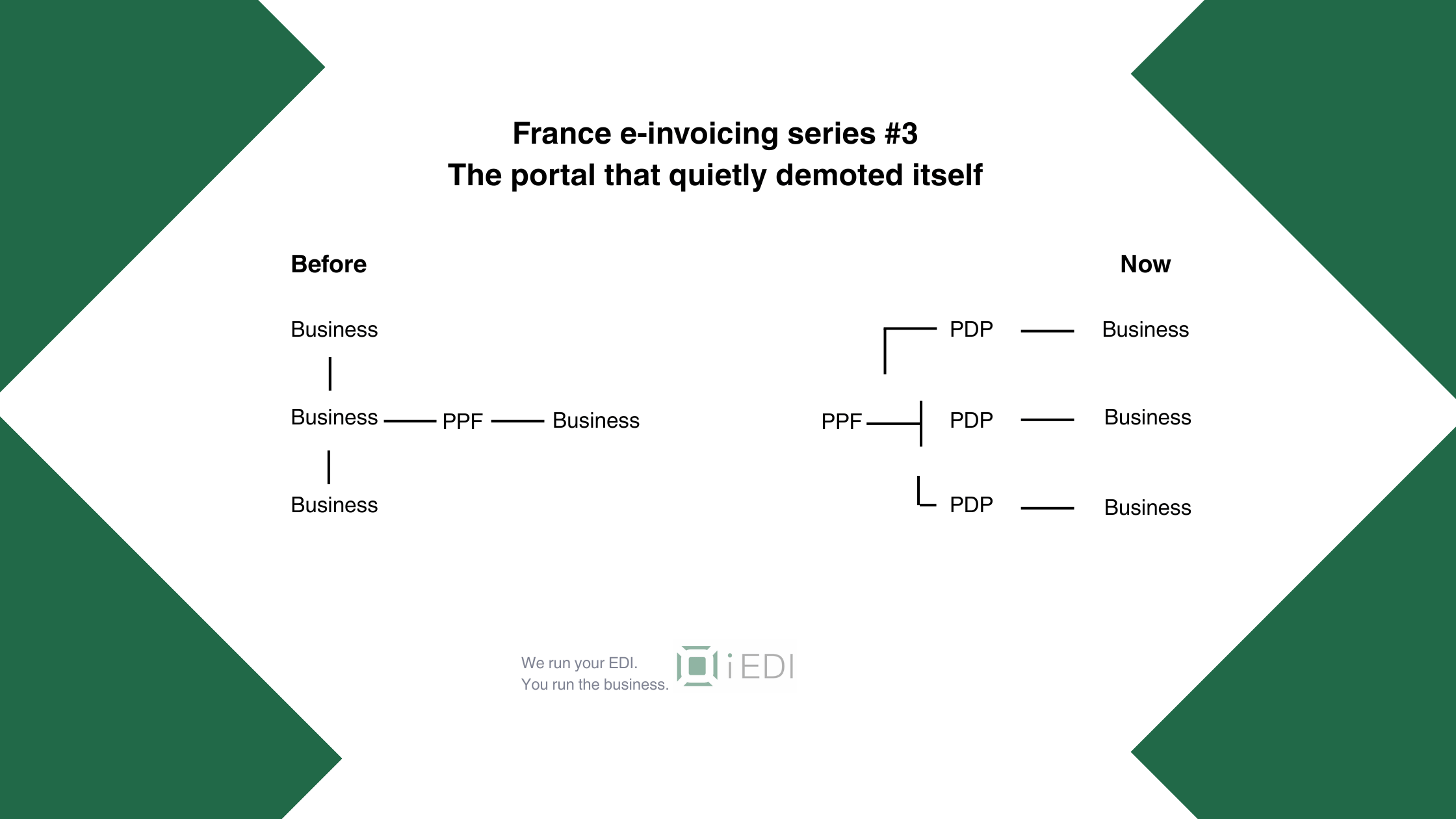
The first versions of France's reform positioned the PPF as the primary platform for exchanging electronic invoices.
Businesses naturally assumed they would connect directly to the government portal, much like connecting to a tax authority or public reporting system. For many finance and IT teams, planning reflected that assumption.
The expectation was simple:
Government platform in the middle, with businesses connected around it.
One central hub.
Then the architecture evolved
As the reform developed, France adopted a different operating model.
Rather than acting as the central exchange platform for every invoice, the PPF became something closer to shared infrastructure.
Its responsibilities now focus on activities such as maintaining the central directory, routing information, and supporting data exchange within the wider ecosystem.
The actual exchange of electronic invoices is expected to happen through certified private platforms, known as Plateformes de Dématérialisation Partenaires (PDPs).
That distinction matters.
Instead of asking:
"How do we connect to the government?"
Businesses increasingly need to ask:
"Which certified platform should we work with?"
Why this matters
On paper, the change looks administrative.
In practice, it changes where implementation work happens.
Choosing the right PDP becomes an important strategic decision.
It's the platform that'll receive, validate, transmit, and manage compliant electronic invoices on behalf of the business.
For many organisations, that relationship will shape their electronic invoicing processes for years to come.
The government still plays an important role.
But it's no longer the organisation that most businesses will interact with on a daily basis.
It's a different way of thinking
Many businesses still imagine the reform as a direct line between themselves and the French authorities, but the reality is that it's closer to a connected network.
Businesses exchange invoices through certified private platforms.
Those platforms communicate within the broader ecosystem while interacting with the PPF where required. The difference may seem subtle, but it changes implementation priorities.
Rather than preparing for a government connection, organisations need to evaluate service providers, integration capabilities, and operational support.
Why businesses are still confused
The confusion is understandable.
Many articles, presentations, and discussions published during the early stages of the reform still describe the original architecture.
Some businesses planned projects based on information that was accurate at the time but has since evolved.
Others have focused so heavily on invoice formats and deadlines that they haven't revisited the underlying infrastructure.
That's why conversations about France's reform often mix old and new terminology.
Everyone is talking about the same regulation. Not everyone is talking about the latest version of it.
What companies should do now
Rather than asking whether the PPF still exists, businesses should ask more practical questions:
-
Who will manage our invoice exchange?
-
Which certified platform best supports our ERP landscape?
-
How will our customers and suppliers connect?
-
How will document validation, monitoring, and support be handled?
These questions have become just as important as understanding invoice formats or compliance deadlines.
The bigger picture
France's evolving architecture highlights something that extends beyond this single reform: Digital transformation rarely follows a perfectly straight line.
Regulations evolve.
Technical models change.
Implementation approaches mature.
Businesses that remain focused only on the original announcement risk preparing for a version of the future that no longer exists.
The organisations that succeed are usually those that continue to adapt as the details become clearer.
The bottom line
The French government's invoicing portal hasn't disappeared, nor has it become less important.
Its role has simply changed.
Instead of acting as the centre of every invoice exchange, it now supports a broader ecosystem built around certified private platforms.
For businesses preparing for France's e-invoicing reform, that changes an important question.
It's no longer simply:
"How do we connect to the PPF?"
It's:
"Who should we connect with to participate in the new ecosystem?"
Sometimes the biggest regulatory changes aren't the ones that make the headlines.
They're the ones that quietly change the way everything else works.


.png?width=2240&height=1260&name=Greeces%20e-invoicing%20deadline%20is%20closer%20than%20you%20think%20-%20blog%20post%20(1).png)