TECHNOLOGY
SUPPLY CHAIN
WHOLESALE
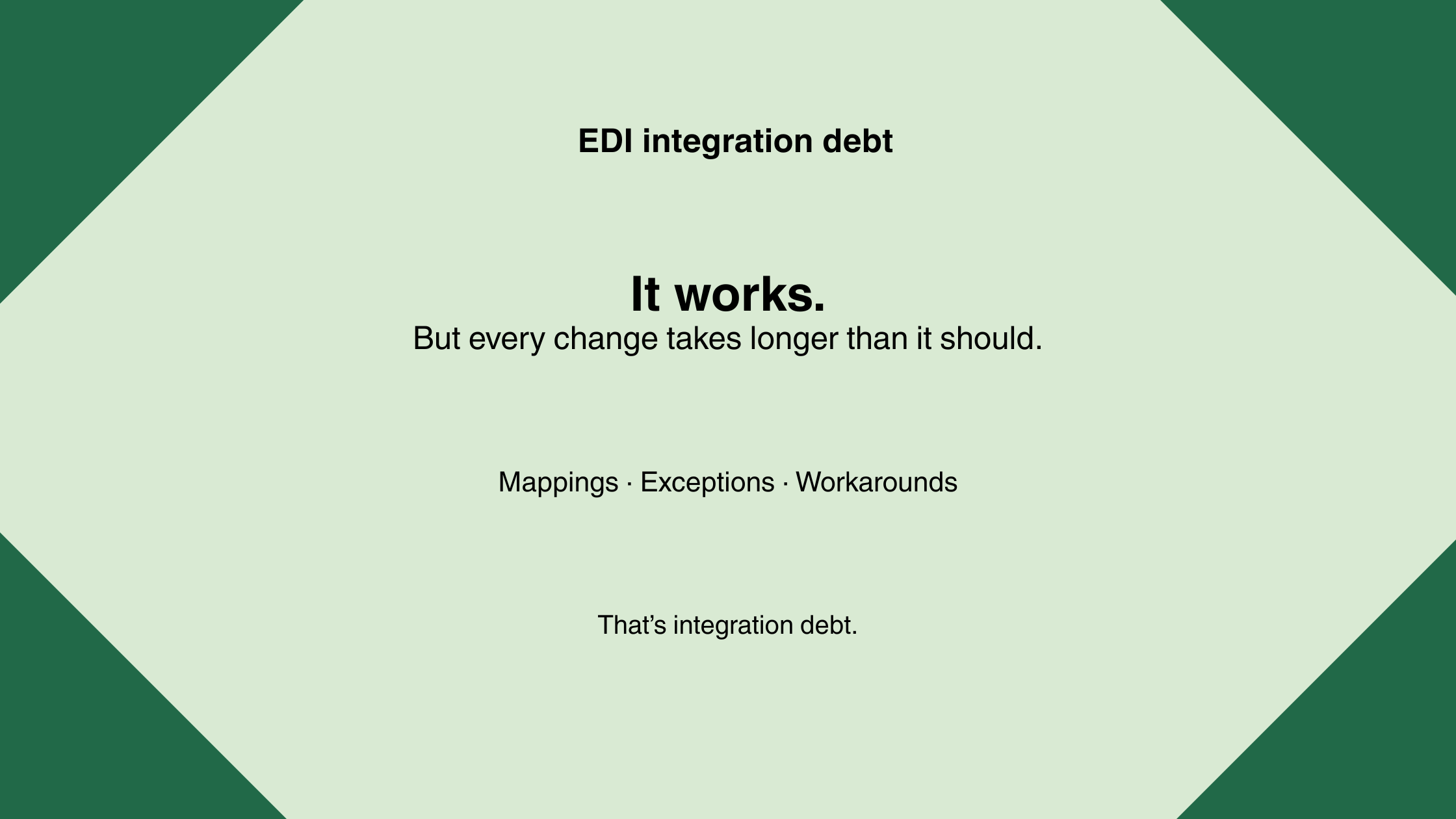

Your orders are arriving, invoices are being sent, and customers aren't complaining. By most measures, your EDI setup is doing exactly what it's supposed to do. But a functioning EDI environment isn't necessarily a healthy one.
Over the years, small changes tend to accumulate. One customer needs a special mapping. Another requires information your ERP doesn't normally provide. A workaround is introduced during an ERP migration, while a retailer asks for an exception to accommodate a particular business process. Later, a trading partner changes its specification and another adjustment is made.
None of these changes is necessarily a problem. In fact, most are perfectly reasonable responses to real business requirements. The difficulty arises when years of adjustments, exceptions and temporary fixes gradually make the integration environment harder to understand and change.
This is what we can think of as EDI integration debt.
Much like technical debt in software development, integration debt doesn't necessarily mean something is broken. The existing setup may continue to work perfectly well. The debt becomes visible when you need to change it – and discover that something which sounds simple is considerably more complicated than expected.
EDI integration debt is the complexity that accumulates when integrations are repeatedly customised and extended without the underlying setup being simplified, documented, or standardised along the way.
Consider a business starting with one ERP system and one EDI customer. The customer sends a purchase order, the EDI solution translates it into a structure the ERP understands, and the order enters the business system automatically.
Then a second customer is onboarded. Their purchase order looks slightly different, so another mapping is needed. A third customer requires additional information. A fourth uses different product identifiers. Over time, the business adds order responses, shipping messages, and invoices. Perhaps it opens another warehouse, introduces a new ERP module, or acquires another company with its own systems and processes.
The growing number of integrations isn't necessarily the problem. That is, growth naturally creates additional complexity.
The problem appears when every new requirement is treated as an entirely separate exception. Instead of having a common integration model with controlled variations, the business gradually ends up with dozens – or potentially hundreds – of slightly different versions of what's fundamentally the same process.
That's when complexity starts turning into debt.
Integration debt rarely exists because someone deliberately designed a bad solution. More often, it's the result of sensible short-term decisions that simply remain in place for much longer than originally intended.
Imagine that a major customer changes its EDI specification and needs the change implemented quickly. Creating a workaround may be the fastest and most practical solution. A few months later, another customer has a similar requirement, but not quite the same one, so another adjustment is introduced. Then an ERP upgrade affects an existing mapping, requiring another exception.
Each decision makes sense in isolation. The problem is that temporary solutions have a habit of becoming permanent infrastructure.
Five years later, someone discovers that one field is transformed differently for a particular customer and asks why. Perhaps the colleague who implemented the change has left the company. Perhaps the original requirement is no longer documented. Perhaps everyone simply knows that the mapping works and is reluctant to touch it.
The result is a familiar situation: nobody is entirely sure why something works the way it does, but everybody knows changing it might have consequences.
That's integration debt becoming operationally significant.
A complicated EDI environment can continue operating for years without creating an obvious crisis. Orders still arrive and invoices still leave, which makes addressing the underlying complexity difficult to prioritise.
The real cost often becomes apparent when the business needs to do something new.
A large customer may need to be onboarded quickly. An existing retailer may introduce new document requirements. The company might migrate to a new ERP system, enter a market with mandatory e-invoicing, or acquire another business with an entirely different integration landscape.
In a manageable EDI environment, these are implementation projects. In an environment carrying significant integration debt, they can quickly become investigation projects.
Before anyone can build the new solution, they first need to understand the old one. Which mappings are still active? Which exceptions represent genuine customer requirements, and which are historical workarounds? Which systems depend on a particular transformation? What happens elsewhere if one mapping is changed?
The biggest obstacle is suddenly not the new integration. It's understanding everything the new integration might affect.
This is why integration debt can remain largely invisible during normal operations while having a significant impact on a company's ability to change quickly.
Some complexity is unavoidable in EDI.
Trading partners have different requirements. ERP systems structure information differently. Industries use different document standards and processes. International businesses increasingly also need to accommodate different national e-invoicing frameworks.
A business with hundreds of trading partners will naturally have a more complex integration environment than one with five.
But complexity and integration debt aren't the same thing.
The important question is how that complexity is managed. If every new customer requirement leads to another bespoke connection deep inside the ERP environment, the number of dependencies can grow quickly. If, instead, an integration layer handles the differences between external partners and internal systems, much of that complexity can be managed in one place.
This is one of the fundamental roles of an EDI platform.
Your ERP shouldn't necessarily need to understand every external file format, communication method, or customer-specific requirement. Instead, the integration layer can translate those differences into a more consistent structure for the systems running the business.
When a trading partner changes its requirements, the aim should therefore be to adjust the translation between the two environments rather than redesigning the internal process every time.
That doesn't eliminate complexity. It puts complexity somewhere it can be managed.
There's another side to integration debt that's easy to overlook: knowledge.
A company may have all the integrations and mappings it needs while still depending heavily on one or two people who understand why they have been configured in a particular way.
That arrangement can work for years. The risk becomes apparent when those people change roles, leave the organisation, or simply can't remember the reasoning behind a decision made many years earlier.
Good documentation is therefore more than administrative housekeeping. It's part of making an integration environment maintainable.
Understanding why a mapping behaves differently, who requested an exception, which business process depends on it and whether the requirement is still relevant can make future changes considerably faster and safer.
Without that information, maintaining older integrations can begin to resemble archaeology: the technical configuration tells you what happens, but someone still needs to reconstruct why.
There is no single measure that tells a business how much integration debt it has accumulated. Often, the best indicators are found in how the organisation responds to change.
If onboarding a relatively straightforward new trading partner consistently takes longer than expected, for example, the problem may not be the new partner at all. The existing environment may simply be difficult to extend.
The same can be true when seemingly minor customer changes require disproportionate amounts of work, or when teams are reluctant to modify old mappings because nobody is entirely sure what else might be affected.
Other warning signs include multiple transformations of the same data in different parts of the integration landscape, manual workarounds surrounding processes that are supposed to be automated, and critical integrations that only one person truly understands.
ERP migrations and upgrades can be particularly revealing. If changing the underlying business system requires untangling a large number of undocumented dependencies and customer-specific exceptions, years of accumulated integration decisions suddenly become very visible.
None of these issues individually means that an EDI environment has been poorly designed. Requirements evolve, businesses grow and exceptions are sometimes necessary. But when several of these symptoms appear together, it may be a sign that complexity has been accumulating faster than it is being managed.
It would be tempting to conclude that the solution is standardisation: make every customer use the same format, remove every exception, and build one universal process.
Unfortunately, that's not how B2B integration works.
EDI exists partly because businesses aren't standardised. Different companies use different ERP systems, identify products differently, operate different warehouse processes, and have different requirements for orders, shipments, and invoices. International e-invoicing is adding another layer, with countries choosing different architectures, formats, and reporting models.
Exceptions aren't inherently a sign of a bad integration environment. Some are simply the reality of doing business with different partners.
The goal isn't therefore to make every trading partner identical. It's to make their differences manageable.
A well-designed integration environment creates a clear boundary between the systems and processes inside the business and the requirements coming from customers, suppliers, and authorities outside it. When an external requirement changes, the business should ideally be able to adjust the relevant integration without unnecessarily disrupting everything behind it.
That ability to absorb change is ultimately more important than achieving theoretical perfection.
Integration debt rarely announces itself.
There's usually no particular day when an EDI environment suddenly becomes too complicated. Instead, complexity accumulates gradually through years of new customers, new mappings, changed specifications, system upgrades, and reasonable short-term decisions.
And because the existing processes continue to work, simplifying them can always be postponed.
That's why the health of an EDI environment shouldn't only be measured by whether messages are successfully being exchanged today.
It should also be measured by how easily the environment can accommodate what the business needs tomorrow.
Can a new customer be onboarded without redesigning existing processes? Can a mapping be changed without uncertainty about what else might break? Can the business migrate ERP systems without first spending months reconstructing years of integration decisions?
Those questions tell you something that message-success rates alone cannot.
At iEDI, we help businesses manage the complexity between ERP systems and external trading partners, including mappings, document formats, customer requirements and changing e-invoicing frameworks.
Because a good integration shouldn't simply work today.
It should remain manageable when the business changes tomorrow.