Supply chains have never been more connected.
Orders flow between retailers, manufacturers, logistics providers, warehouses, and suppliers every minute of every day.
Behind almost every transaction sits an ERP system, a warehouse management system, a transport management system, and, somewhere in between, an EDI platform ensuring that structured business documents move from one organisation to another.
Yet many companies still struggle to modernize these connections, not because EDI is outdated, but because the infrastructure surrounding it often is.
This is where cloud EDI changes the conversation.
Why traditional EDI becomes difficult to scale
Many businesses implemented EDI years - even decades - ago.
At the time, it solved a very specific problem: exchanging purchase orders and invoices electronically with a handful of customers.
Fast forward to today, and the requirements have changed dramatically.
Companies now need to:
- onboard new trading partners quickly
- support multiple ERP systems
- exchange more document types
- connect with logistics providers
- comply with evolving e-invoicing regulations
- support APIs alongside traditional EDI
The original EDI solution often still works.
But every new connection feels like another custom project. But that's not an EDI problem. It's an infrastructure problem.
The biggest EDI integration challenges
For supply chain and IT teams, modernisation rarely fails because of document formats. Instead, the biggest barriers are operational.
Slow partner onboarding
Every retailer, supplier, or logistics provider has different requirements.
If onboarding each one takes weeks, growth stagnates.
Legacy ERP integrations
Many organisations operate several ERP systems simultaneously.
Cloud EDI helps bridge those environments without rebuilding every integration.
Multiple standards
A single company may exchange:
- EDIFACT
- ANSI X12
- Peppol BIS
- OIOUBL
- XML
- CSV
Managing those standards internally quickly becomes complex.
Limited visibility
One of the most common frustrations with older EDI environments is simply not knowing when something has failed.
Modern cloud EDI platforms provide monitoring, alerts, and reporting that allow issues to be resolved before they impact operations.
How cloud EDI supports supply chain automation
Modern supply chains depend on structured, reliable information.
Cloud EDI enables that by acting as the integration layer between:
- ERP systems
- warehouse management systems
- transport management systems
- eCommerce platforms
- finance systems
- customers
- suppliers
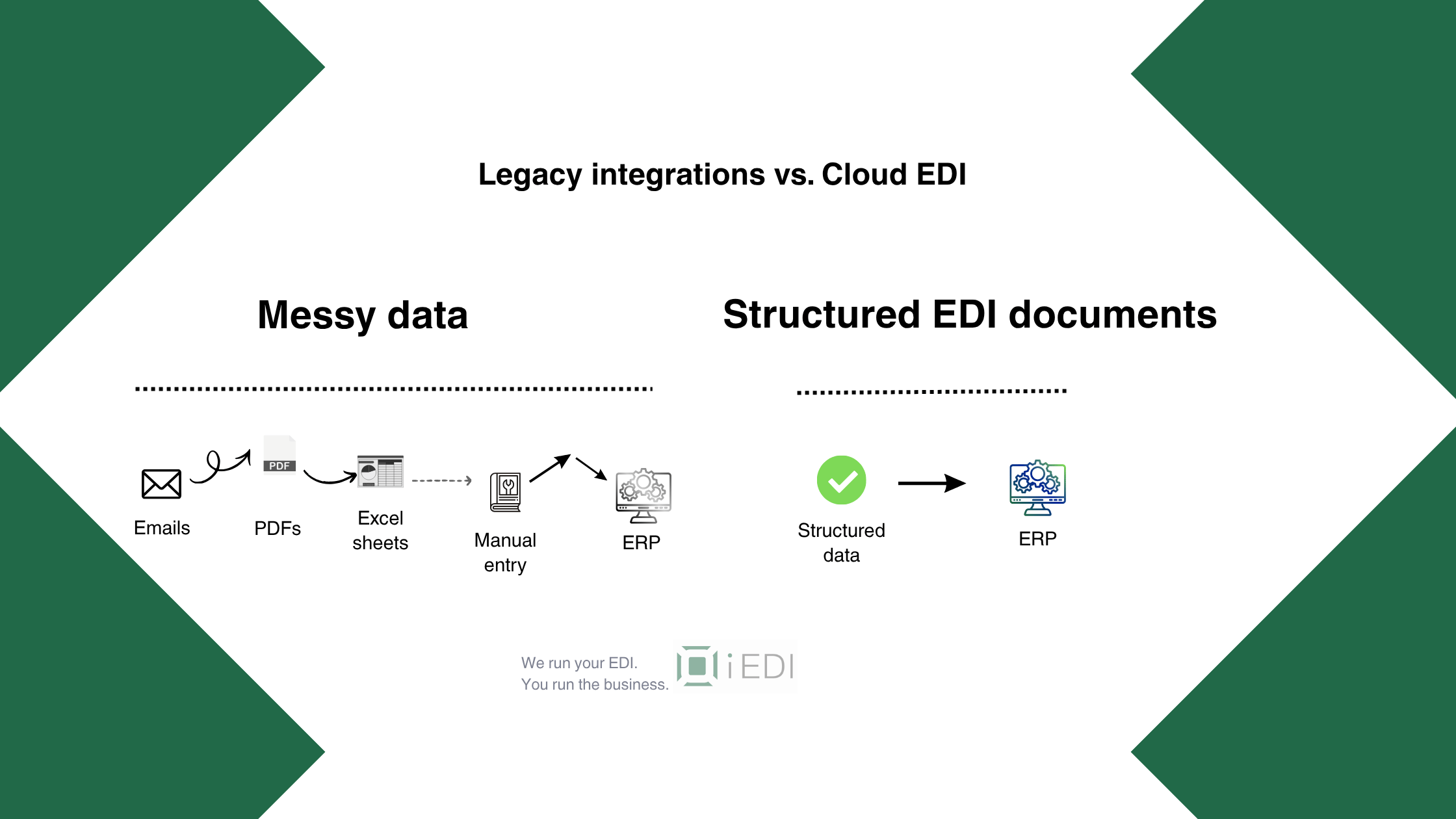
Instead of every system communicating individually, cloud EDI standardises and orchestrates document exchange.
The result is fewer manual processes and greater consistency across the entire supply chain.
EDI isn't replacing ERP
One misconception is that cloud EDI is replacing existing business systems. It doesn't.
ERP systems remain the operational backbone. Cloud EDI simply ensures the right information reaches them in a structured format.
That means:
- purchase orders arrive automatically
- invoices can be validated
- shipment notifications flow correctly
- inventory updates become more reliable
The ERP becomes more valuable because the incoming data is more consistent.
Choosing the right cloud EDI provider
Not every organisation needs the same approach.
A manufacturer exchanging millions of documents annually has different requirements than a regional distributor onboarding dozens of suppliers.
When evaluating cloud EDI providers, consider questions such as:
- How quickly can new trading partners be onboarded?
- Which EDI standards and protocols are supported?
- Can the platform integrate with existing ERP systems?
- Does it support both traditional EDI and modern APIs?
- How much visibility is available into document flows?
- Can the platform adapt to changing compliance requirements?
Modern EDI should reduce complexity, not create more of it.
Modernisation is about agility
Supply chain modernisation is often discussed in terms of automation, AI, and digital transformation.
But those initiatives rely on one thing above everything else: Reliable, structured data.
Cloud EDI helps create that foundation. By simplifying integrations, supporting multiple standards, and improving visibility across trading partners, it allows businesses to modernize without rebuilding their entire IT landscape.
In conclusion
Cloud EDI isn't simply a different deployment model - it's a different way of managing business connectivity.
Instead of treating every new integration as a standalone project, businesses gain an adaptable platform that grows alongside their supply chain.
In a market where customer expectations, regulations, and trading partner requirements continue to evolve, that flexibility becomes a competitive advantage.
Whether you're replacing a legacy EDI environment or planning your next ERP modernisation, cloud EDI can help simplify integration and improve supply chain automation.
Talk to one of our EDI specialists to learn how iEDI helps businesses modernize document exchange without unnecessary complexity.

.png?width=2240&height=1260&name=Peppol%20LP%20banner%20(2).png)