
COMPLIANCE
E-INVOICING
INTEGRATION

EDI standards exist for one reason: to make business systems understand each other.
Orders, invoices, credit notes, delivery notes, and shipment messages all need structure. Without a shared structure, every trading partner becomes a custom integration project.
That is what EDI standards solve.
But the landscape isn't simple. Enterprises operating across Europe and globally may need to support EDIFACT, ANSI X12, Peppol, OIOUBL, TRADACOMS, KSeF, and PDP models at the same time.
The important point is this:
You don't choose one EDI standard for your entire business.
You choose the right standard for each market, partner, and document flow.
An EDI standard defines how business data should be structured so it can move between systems automatically.
It answers questions like:
EDI standards are what make automated document exchange possible.
Without them, companies fall back to PDFs, emails, spreadsheets, and manual re-entry.
EDIFACT is one of the most widely used EDI standards in the world, especially across Europe and international supply chains.
It is common in:
Typical EDIFACT messages include:
EDIFACT is powerful because it's mature, flexible, and globally understood. But that flexibility also creates complexity. Different partners often implement the same message type differently.
That means EDIFACT is rarely “plug and play”. It requires mapping, validation, and partner-specific handling.
Best fit: large enterprises, international supply chains and complex B2B document flows.
ANSI X12 is the dominant EDI standard in the United States and much of North America. ANSI X12 and EDIFACT are described as two of the most important global EDI standards, with X12 especially common in the US market.
Typical X12 transaction sets include:
If your enterprise sells to American retailers, distributors, healthcare organisations, or logistics networks, X12 is often unavoidable.
For European companies expanding into the US, this is usually the first major format shift they encounter.
Best fit: North American retail, manufacturing, healthcare, logistics, and enterprise supply chains.
Peppol is often discussed as if it were an EDI format. That's not entirely correct.
Peppol is a network and interoperability framework for exchanging structured electronic documents. It uses common specifications such as Peppol BIS Billing 3.0, built around European e-invoicing standards.
Peppol is increasingly important because it supports:
OpenPeppol maintains formal documentation for the network, including technical specifications and governance documents.
The strength of Peppol is interoperability.
Instead of building one connection per partner, companies connect through a certified access point and exchange documents with other participants in the network.
Best fit: e-invoicing, public sector trade, European B2B compliance, and cross-border document exchange.
OIOUBL is Denmark’s national document standard, closely connected to NemHandel.
In Denmark, electronic invoicing is mandatory when supplying goods and services to public authorities. OpenPeppol notes that invoice senders can use either Peppol or the national OIOUBL format, while public sector recipients must support both.
OIOUBL covers more than invoices. The official OIOUBL material describes standards for key business documents across the trade process, from catalogue to invoice.
For companies trading in Denmark, OIOUBL remains important because many public and private workflows still depend on it.
Best fit: Danish public sector invoicing, NemHandel, Danish B2B document exchange, and local compliance.
TRADACOMS is an older UK EDI standard, historically used in retail and grocery supply chains.
It has been partly replaced by EDIFACT in many areas, but it is still found in legacy retail environments. TRADACOMS is listed alongside ANSI X12, EDIFACT, EANCOM, and XML as one of the major EDI standards used worldwide.
For enterprises working with UK retailers, TRADACOMS may still appear in:
The challenge with TRADACOMS is not popularity. It's legacy dependency. Some partners still require it because their internal systems and workflows were built around it.
Best fit: UK retail, grocery, wholesale, and legacy trading partner requirements.
KSeF isn't a traditional EDI standard. It's Poland’s national e-invoicing system.
KSeF stands for Krajowy System e-Faktur, or the national e-invoicing system. It's a central government platform for issuing, receiving, and storing structured invoices in Poland.
Invoices in KSeF are structured XML documents and several sources note that Poland is moving to the FA(3) XML schema as part of the mandatory e-invoicing rollout.
This matters because companies trading in Poland can't simply send a PDF or generic invoice file. They must comply with the KSeF model and its structured invoice requirements.
Best fit: Polish B2B and B2G e-invoicing compliance.
PDP refers to France’s partner dematerialisation platform model.
Like KSeF, PDP isn't an EDI standard in the classical sense. It's part of a national e-invoicing and e-reporting infrastructure.
France is moving toward mandatory B2B e-invoicing and e-reporting. The French model requires invoices to move through accredited platforms. The French public service portal states that invoices must transit through a platform used by the issuer and recipient, and that this platform must be a partner dematerialisation platform accredited by the tax authorities.
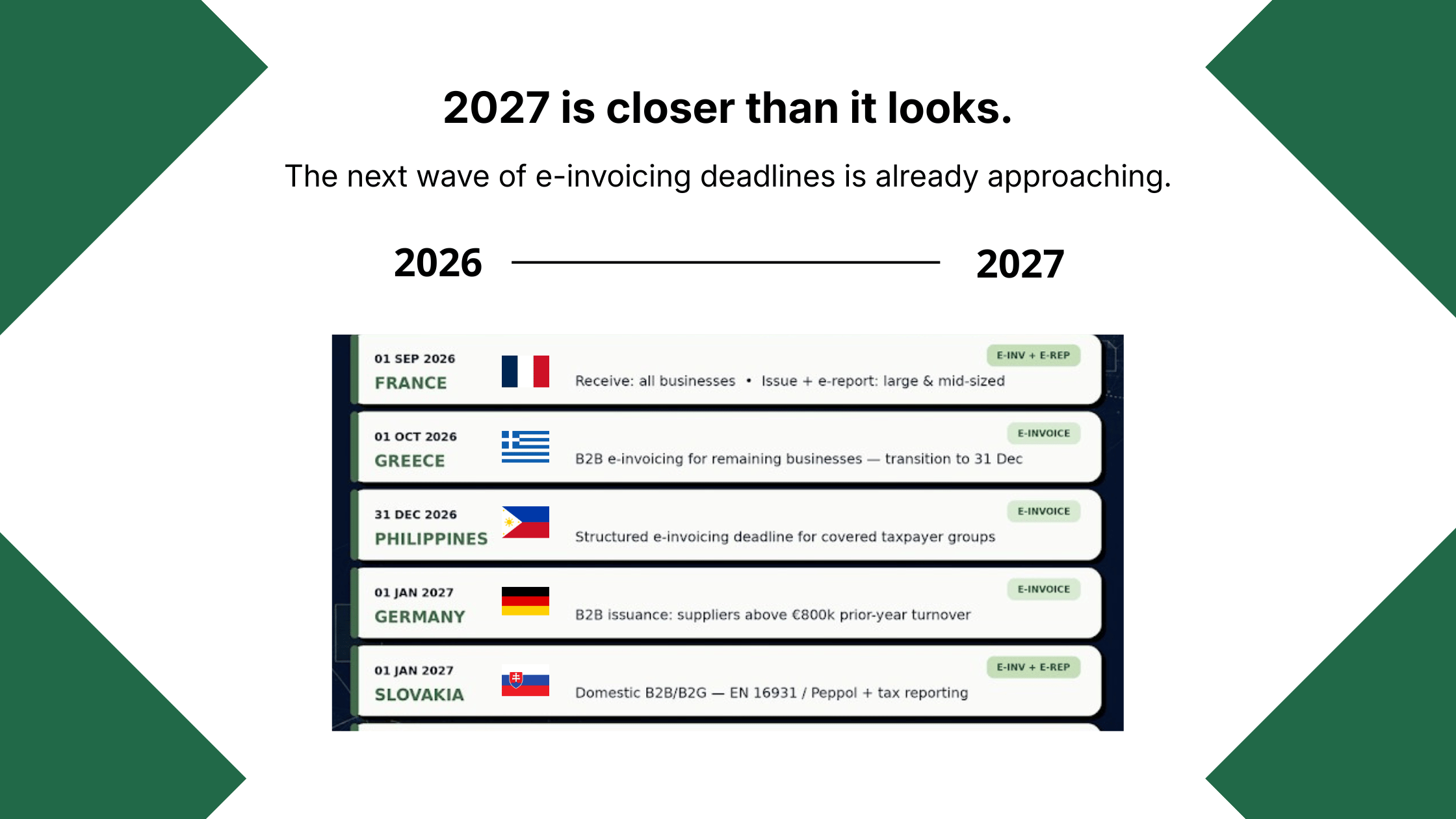
France’s rollout begins with mandatory receiving requirements from September 2026, according to the European Commission’s country information.
For enterprises, the key point is that France introduces a compliance infrastructure layer. You're not only choosing a format. You're choosing how invoices are routed, validated, and reported.
Best fit: French B2B e-invoicing, e-reporting, and tax compliance.
Enterprises usually don't choose standards based on preference.
They choose based on five practical questions.
Geography matters.
The first step is always market mapping.
Large customers often dictate the standard.
A retailer, public authority, or marketplace may require a specific format, protocol, or validation rule. Trading partners define guidelines that specify required transaction structures, mandatory fields, and allowed values.
That's how EDI works in practice.
The “standard” is only the starting point. The partner implementation guide is what usually decides the final mapping.
Different standards are stronger in different flows.
For example:
If your business only sends invoices, the decision may be simpler.
If you exchange orders, confirmations, shipping notices, catalogues, labels, and invoices, you need a broader EDI architecture.
Classic EDI standards often solve operational exchange.
National e-invoicing systems solve compliance.
The future is a combination of both.
An enterprise may use EDIFACT for logistics and order flows, Peppol for e-invoicing, KSeF for Polish compliance, and X12 for US trading partners.
That's not unusual.
It's the normal reality of enterprise EDI.
The real question is not whether your business can “choose” between EDIFACT, X12, Peppol, or KSeF.
The real question is whether your EDI setup can handle all of them.
Modern enterprises need a translation layer that can:
This is where provider choice matters.
| Standard/ model | Most common region | Typical use | Best for |
|---|---|---|---|
| EDIFACT | Europe/global | Orders, invoices, despatch advice, catalogues | Enterprise supply chains |
| ANSI X12 | North America | Orders, ASNs, invoices, acknowledgements | US retail, logistics, healthcare |
| Peppol | Europe/global expansion | E-invoicing, procurement documents | Interoperable e-invoicing and public sector trade |
| OIOUBL | Denmark | Danish e-invoicing and business documents | NemHandel and Danish compliance |
| TRADACOMS | United Kingdom | Retail and grocery EDI | UK legacy retail flows |
| KSeF | Poland | Structured e-invoicing | Polish tax compliance |
| PDP/PA model | France | E-invoicing and e-reporting | French tax compliance |
EDI standards reduce complexity.
They don't remove it entirely.
Why?
Because every enterprise still has:
That's why EDI isn't just about supporting a list of formats.
It's about managing the translation between them.
Multi-format support can be described as a way to simplify format complexity, stay compliant with trading partner requirements, and deliver validated data for each transaction.
That's the practical challenge enterprises need to solve.
The future of EDI isn't one global standard.
It's a multi-standard reality.
Enterprises need to support:
The right question isn't:
“Which EDI standard should we choose?”
The better question is:
“Can our infrastructure support every standard our business needs — without creating a new project every time?”
That is where modern EDI should be heading.
If your business needs to support EDIFACT, X12, Peppol, OIOUBL, TRADACOMS, KSeF, PDP or other local requirements, we can help you map the right setup.
Speak to our iEDI expert and see how one infrastructure can support every standard your partners require.
.png?width=2240&height=1260&name=Greeces%20e-invoicing%20deadline%20is%20closer%20than%20you%20think%20-%20blog%20post%20(1).png)