Greece e-invoicing 2026: What businesses need to know
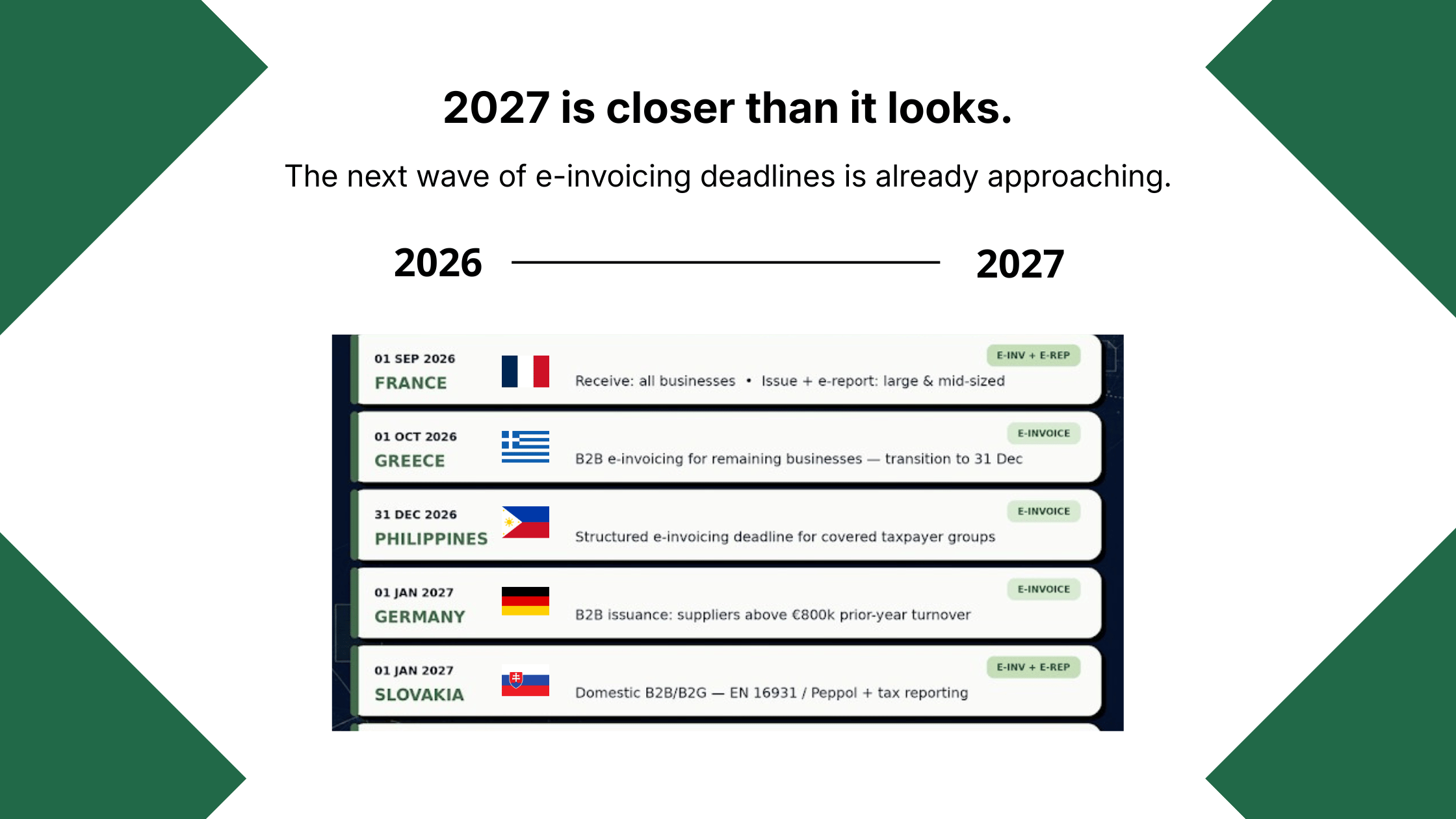
If you follow European e-invoicing developments, September 2026 probably has one country written all over it: France.
And understandably so. France's reform is one of Europe's biggest e-invoicing projects.
But while everybody is watching France, another deadline arrives just one month later.
1 October 2026. Greece.
From that date, Greece's mandatory B2B e-invoicing regime expands to the remaining businesses within scope.
For companies doing business in Greece, that's a date worth putting in the calendar now.
Because Greece isn't simply replacing PDF invoices with electronic ones. It's building e-invoicing around an existing digital tax infrastructure, myDATA, and the resulting model is somewhat different from what businesses may encounter elsewhere in Europe.
Greece has already started
The October deadline isn't the beginning of Greek e-invoicing.
It's the next phase.
Greece has operated mandatory myDATA reporting for businesses for several years, while electronic invoicing for public contracts is already in place.
Mandatory domestic B2B e-invoicing is now being introduced in stages.
The first period covers businesses with gross revenue exceeding €1 million, based on their 2023 income tax return. Following an adjustment to the original timetable, that obligation took effect on 2 March 2026.
The second period covers the remaining businesses and begins on 1 October 2026.
There is, however, an important nuance. Businesses in the second period can make use of a gradual transition between 1 October and 31 December 2026 while continuing to use other issuance and transmission methods, provided they submit the required declaration in time and specify commencement no later than 1 October.
So October isn't quite the cliff edge a headline might suggest, but neither is it a reason to wait until December.
myDATA is at the centre of the Greek model
This is where Greece becomes particularly interesting.
Businesses familiar with Peppol might expect an e-invoice simply to travel electronically from supplier to buyer.
Greece adds another important participant: the tax authority's myDATA platform.
Invoices issued through a certified electronic invoicing provider are transmitted automatically and in real time to myDATA. The platform performs controls and assigns the invoice its unique registration number, or MARK.
In other words, the tax authority isn't waiting for invoice information to be reported much later.
It becomes part of the digital flow.
That's an important conceptual change for businesses accustomed to thinking about invoicing and tax reporting as two separate processes.
And where does Peppol fit?
This is another area where it's easy to mix together different parts of the Greek system.
Peppol already plays a role in Greek B2G electronic invoicing.
For invoices to the Greek state, electronic invoices can travel through the Peppol network and the government's interoperability infrastructure. AADE specifically describes e-invoices to the Greek State being sent via Peppol and the Interoperability Center.
That doesn't mean the entire Greek B2B mandate can simply be summarised as "Greece is moving to Peppol."
It can't.
For businesses, understanding which transaction is involved, which channel applies, and how that exchange connects with myDATA is much more useful than simply asking whether Greece "uses Peppol."
A PDF still isn't the point
This distinction matters because electronic invoicing is still sometimes understood as:
"We already email our invoices as PDFs."
That's digital delivery.
It isn't necessarily structured e-invoicing.
A true e-invoice contains structured data that systems can process automatically. That's what allows invoice information to move from one business system to another without somebody opening an attachment and typing information into an ERP.
The EU itself defines an e-invoice as one issued, sent, and received in a structured form that enables automatic electronic processing.
Greece takes that a step further by connecting invoice issuance with myDATA.
The result is less room for manual intervention between invoice creation, validation, reporting, and processing.
There's also an incentive not to wait
Interestingly, Greece isn't relying entirely on deadlines to encourage adoption.
Businesses that voluntarily adopt qualifying electronic invoicing sufficiently early may receive tax incentives.
Under the conditions published by AADE, these include an additional 100% depreciation of expenditure for the initial technical equipment and software required for e-invoicing in the year of purchase, as well as an additional 100% deduction for qualifying invoice production, transmission, and electronic archiving expenditure during the first 12 months.
To qualify, businesses must meet the relevant conditions, including declaring and beginning their use of electronic invoicing no later than two months before their mandatory start date.
It's an interesting approach:
Prepare early, and there may actually be a financial benefit to doing so.
What should businesses be looking at now?
The first question shouldn't simply be:
"Can our ERP create an electronic invoice?"
The more useful questions are broader.
-
How are Greek invoices currently created? Which transactions fall within the mandate?
-
How will invoices reach myDATA?
-
Does the current ERP contain the data required by the new process?
-
Is a certified provider needed?
-
What happens when an invoice fails validation?
-
And how does the setup interact with existing EDI or international invoicing flows?
For companies operating across several European markets, there is another question worth asking:
Are we solving Greece as an isolated compliance project, or as part of our wider European e-invoicing strategy?
That distinction is going to become increasingly important.
Greece isn't an isolated case
France in September. Greece in October.
Other European countries introducing or expanding their own requirements around them.
The direction is clear, even if the individual systems aren't identical.
Europe is steadily moving away from invoicing built around documents that people read and towards invoicing built around structured data that systems exchange.
Greece is another important step in that transition.
It may not currently be getting as many headlines as France.
But for businesses affected by the October deadline, that won't make the implementation any less real.
At iEDI, we help businesses manage electronic document exchange across countries, formats, and trading-partner requirements through one managed setup.
If Greece is part of your e-invoicing landscape, now is a good time to understand what the October deadline means for your existing invoice flows.

.png?width=2240&height=1260&name=Greeces%20e-invoicing%20deadline%20is%20closer%20than%20you%20think%20-%20blog%20post%20(1).png)

.png?width=2240&height=1260&name=Why%20EDI%20integrations%20stall%20and%20how%20to%20fix%20them%20(1).png)