2027 may feel far away.
For an e-invoicing project, it really isn’t.
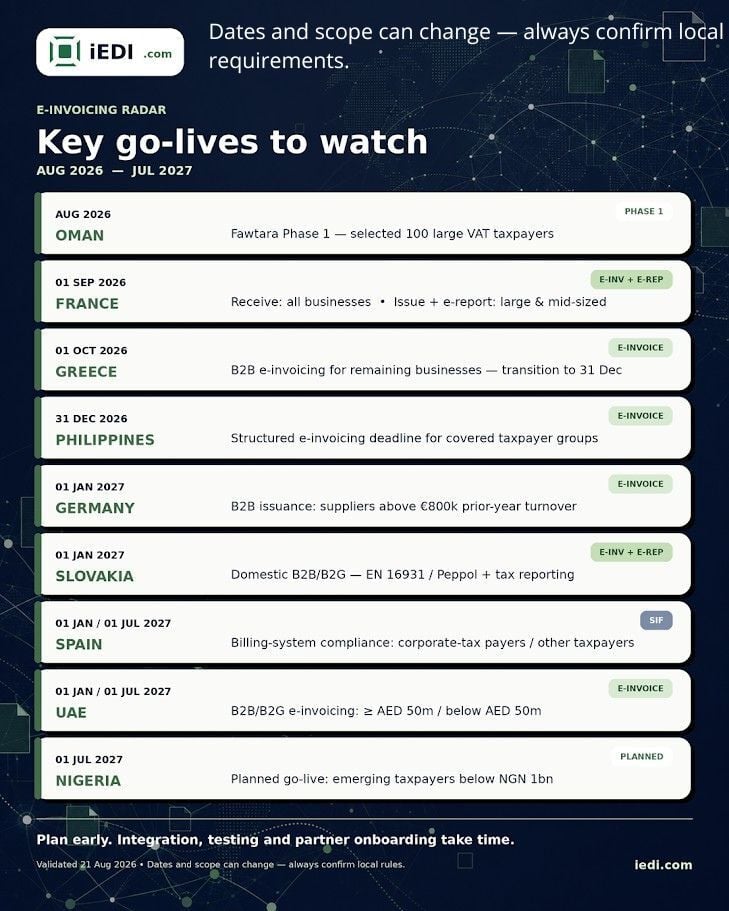
Across Europe, the Middle East, Africa, and Asia, governments are introducing or expanding requirements for structured e-invoicing, digital reporting, and compliant billing systems. Some changes arrive before the end of 2026. Others take effect during 2027.
The individual rules differ considerably from one country to another. But for businesses operating internationally, the practical challenge is increasingly familiar: another market, another deadline, another set of technical and compliance requirements that need to work with the systems already in place.
And that is why the important date is rarely just the official go-live date.
For many businesses, preparation needs to start months earlier.
The e-invoicing calendar is getting crowded
France is understandably receiving considerable attention at the moment.
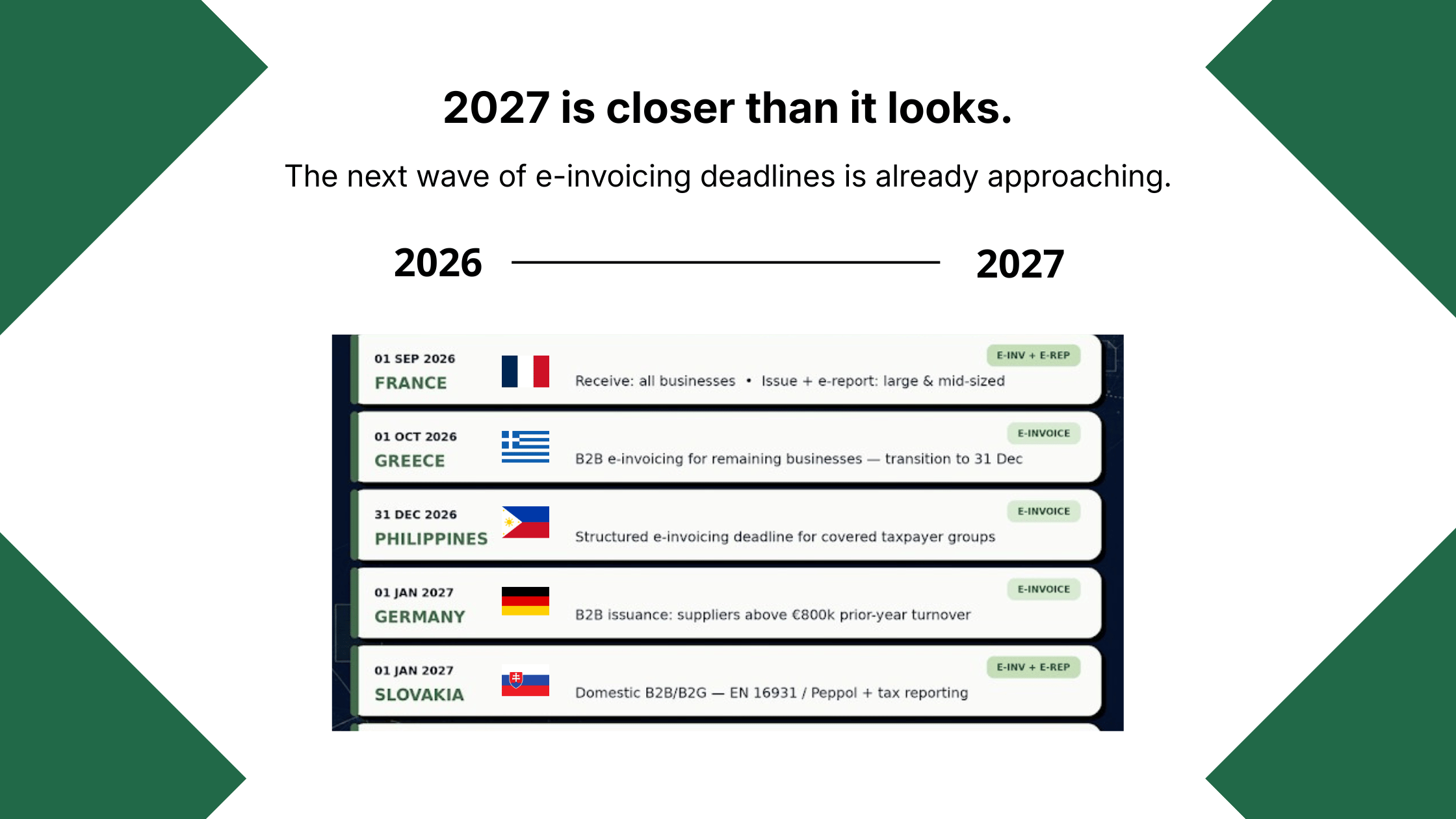
From 1 September 2026, all French businesses must be capable of receiving electronic invoices, while large and mid-sized businesses also enter the first phase of mandatory issuance and e-reporting. Smaller businesses follow with their issuance obligations in 2027.
But France is only one part of a much broader shift.
Greece is continuing its phased introduction of mandatory B2b e-invoicing in 2026. Slovakia is preparing for mandatory domestic B2B e-invoicing and real-time reporting from January 2027. Germany is continuing its own transition towards mandatory B2B e-invoice issuance. And outside the EU, countries including the UAE are developing frameworks of their own.
Different countries. Different models. Increasingly similar questions for the businesses affected.
Can our existing infrastructure actually support all of this?
The deadline is only the visible part
It's tempting to look at an e-invoicing mandate as a compliance date.
Before a company can send a compliant invoice, however, several things may need to happen behind the scenes.
ERP and accounting systems need to produce the right information. Invoice data needs to be mapped into the required structure. Local validation rules need to be understood. Connections to Peppol networks, accredited providers, or national platforms may need to be established.
Then everything needs to be tested.
And for businesses exchanging documents with hundreds or thousands of customers and suppliers, there is another challenge: trading partner onboarding.
None of that happens automatically when the mandate takes effect.
This is why a deadline in January or July 2027 can quickly become a project for 2026.
One trend, many different models
Perhaps the biggest mistake multinational businesses can make is assuming that “e-invoicing” means roughly the same thing everywhere.
It doesn’t.
Countries are approaching digital invoicing and reporting in different ways. Some use Peppol-based infrastructures. Others rely on central government platforms, clearance models, or accredited private providers. Some require invoice information to be reported to tax authorities. Others focus primarily on structured document exchange.
Even within Europe, businesses therefore can't simply build one country-specific solution and assume the job is done.
The underlying question becomes broader:
How easily can your document infrastructure adapt when the next country changes its rules?
That matters particularly for businesses operating across multiple markets. A series of individual compliance projects can quickly leave an organisation with separate connections, mappings, and processes for every country.
The alternative is to think about e-invoicing as part of a wider B2B document strategy.

.png?width=2240&height=1260&name=Greeces%20e-invoicing%20deadline%20is%20closer%20than%20you%20think%20-%20blog%20post%20(1).png)

.png?width=2240&height=1260&name=Why%20EDI%20integrations%20stall%20and%20how%20to%20fix%20them%20(1).png)