Skip to content
COMPLIANCE E-INVOICING

International growth requires digital readiness

Daniel Schou Mørch Vlad

Read the original article in Børsen (in Danish). INSERT LINK

New customers, logistics, and local market knowledge are central elements when Danish companies expand to new markets. However, national requirements for electronic invoicing and digital exchange of trade documents can easily get overlooked in the process. So how can companies ensure that the digital requirements don’t become an administrative obstacle to international growth? 

International growth under administrative pressure

Danish companies operating in the EU are facing increasing pressure on their competitiveness. According to a May 2025 analysis by Dansk Industri (the Confederation of Danish Industry), 94% of surveyed companies with economic activities in the EU that don’t expect to increase their engagement consider reducing administrative burdens a high priority. These companies also call for fewer barriers to trade within the EU’s single market.

When operating across borders, companies must navigate different national regulations, systems, and documentation requirements. This applies not only to digital businesses such as online retailers, but also in terms of the digitalisation of trade processes, including the exchange of orders, invoices, and shipping information.

For companies operating in multiple countries, varying national requirements can make the exchange and management of trade documents increasingly complex.

E-invoicing - one European market, many sets of rules

An electronic invoice is more than a PDF sent by e-mail. It’s an invoice issued in a structured digital format which enables systems to process the information automatically.

This can reduce the need for manual data entry, saving time and minimising the risk of human error.

However, this doesn’t necessarily mean that companies can use the same invoicing process across borders. Several European countries have already introduced mandatory e-invoicing for certain businesses and transactions, but the requirements vary from country to country.

The first phase of France’s e-invoicing reform took effect on the 1st of September 2026, with additional requirements scheduled for September 2027.

Belgium’s e-invoicing reform already took effect for most domestic B2B transactions in January 2026.

Some countries require reporting to tax authorities or specific platforms, while others allow documents to be exchanged through approved networks and service providers.

An ERP or accounting system that meets the requirements in Denmark may not necessarily support those of other countries. Businesses operating across multiple markets may therefore need to adapt their existing systems and invoicing processes.

Digital infrastructure as a driver of growth

In many cases, an existing ERP and accounting system can be integrated with solutions that handle different national formats and document exchange requirements..Thus, companies can often retain their existing systems while adapting to new markets.

EDI (Electronic Data Interchange) enables the automatic exchange of trade documents between business systems.

Automating this exchange can reduce manual data entry, free up employee time, and reduce the risk of errors.

By connecting trade processes through an integrated digital infrastructure, companies can reduce their dependence on separate manual workflows for each new market. This can also reduce the need for extensive IT customisation when expanding internationally or establishing relationships with new trading partners.

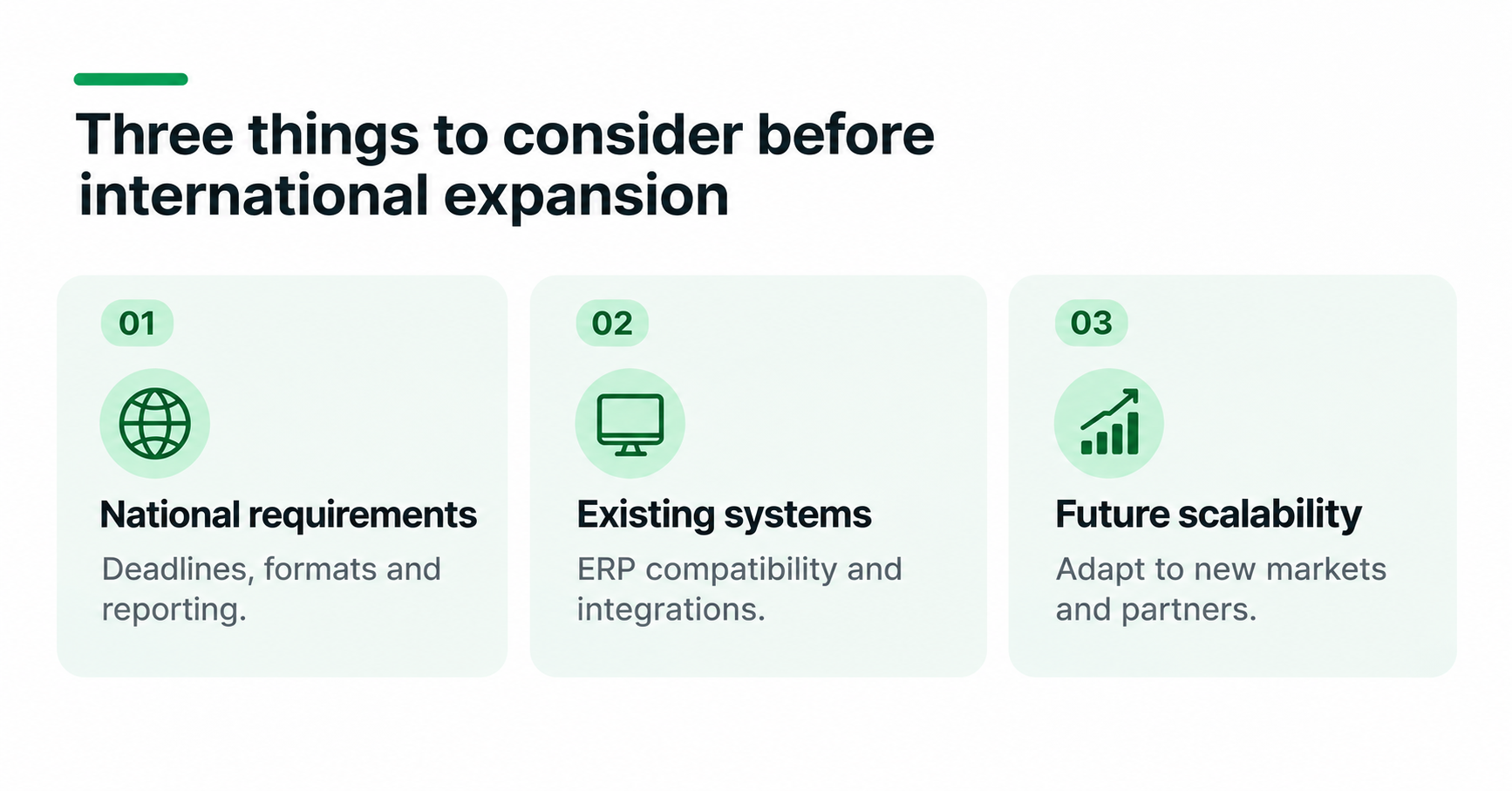
Tre overvejelser før international ekspansion

From digital requirements to real-world practice

Dacapo Stainless, a Danish company specialising in stainless steel products and solutions, uses an EDI solution that allows it to send a single file format to iEDI, which then handles different document formats and exchange requirements across markets. This can reduce the need for separate integrations and local IT modifications.

Digital readiness should be part of the growth strategy

Anita Petersen, CEO & Partner at iEDI, sees digital infrastructure as an important part of companies’ international trade operations.

“You can have an international growth strategy and still end up with an invoice that can’t make it across the border. E-invoicing should therefore be part of the strategy from the outset.”

When planning for international expansion, companies should consider the digital requirements of new markets alongside logistics, local market conditions, and customer acquisition. Doing so can help reduce the risk of unexpected administrative challenges and make it easier to comply with national regulations.

Share this post