
SUPPLY CHAINCUSTOMER CASEFEATURED

Most businesses don't start looking for an EDI provider because they suddenly become interested in electronic data interchange.
Usually, something has happened.
A major customer has introduced new EDI requirements. The business is implementing a new ERP system. Its existing integration setup has become difficult to maintain. Or the number of trading partners has grown to a point where manual processes are no longer practical.
Whatever the reason, the immediate question is often fairly straightforward: Who can connect our systems with our customers and suppliers?
And naturally, businesses begin comparing providers based on supported formats, integration capabilities, implementation timelines, and pricing.
Those are important considerations. But they don't necessarily tell you what working with a provider will be like once the project begins – or what happens when something changes two years later.
The right EDI provider needs to do more than establish a connection. They need to help you manage a business process that depends on information moving reliably between organisations.
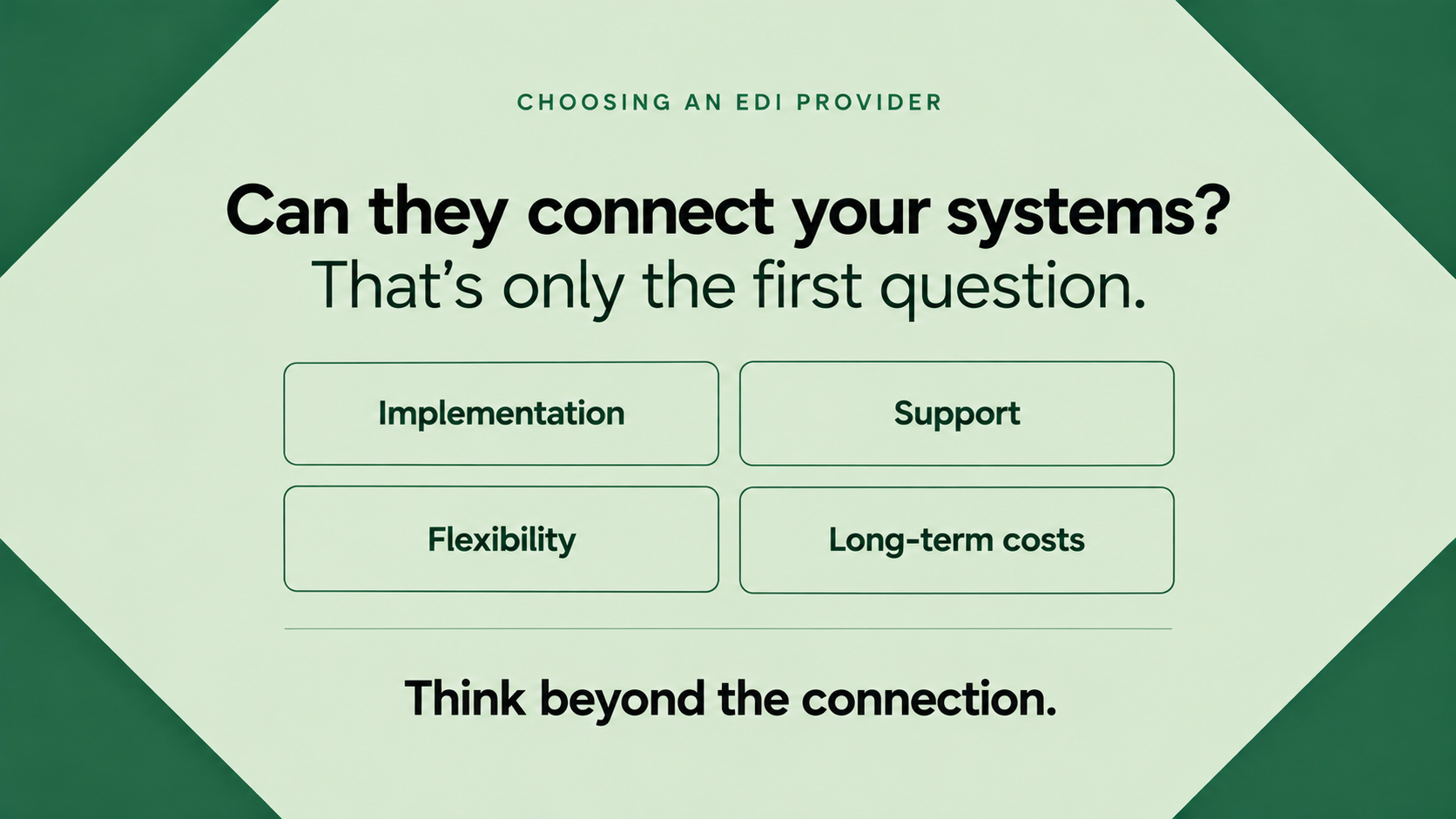
So before choosing a provider, there are several questions worth exploring beyond the technical specifications.
Almost every EDI provider can explain which standards and communication methods they support.
You might see references to EDIFACT, ANSI X12, XML, AS2, SFTP, APIs, Peppol, and a long list of ERP systems.
But supporting a particular standard isn't necessarily the same as having an established integration with your specific ERP configuration.
Two businesses using the same ERP can have very different setups. One may use standard functionality, while another relies on custom fields, extensions or processes developed over several years.
The relevant question isn't simply whether the provider supports your ERP; it's how the integration will work in your environment.
Which information can be exchanged automatically? Will custom development be necessary? Who's responsible for maintaining the ERP-side integration? And what happens when your ERP is upgraded?
A provider should be able to explain the proposed architecture in terms that make sense to both IT and the people responsible for the business process.
You shouldn't need to become an EDI specialist to understand what you're buying.
One of the reasons EDI can become complicated is that trading partners don't always follow identical requirements.
Two customers may use the same EDI standard but expect different fields, product identifiers, document structures, or validation rules.
One retailer may require electronic purchase orders and invoices. Another may also expect order responses, shipping notices, and SSCC information.
The challenge isn't simply connecting to each customer. It's accommodating those differences without turning your internal systems into a collection of customer-specific workarounds.
This is where it becomes useful to ask how the provider manages mapping, transformation, and trading partner requirements.
Can they adapt to different customer specifications? How are changes managed? What happens when an existing trading partner updates its requirements?
And perhaps most importantly, how much of that complexity will your own business need to handle?
A good EDI setup should make it easier to work with different trading partners, not require your ERP to behave differently for every customer.
An EDI project involves more than configuring a technical connection.
Requirements need to be clarified. Documents need to be mapped. Test transactions need to be exchanged. Errors need to be investigated. And someone needs to coordinate the process between your business, the EDI provider, and the trading partner.
Before signing an agreement, it's worth understanding how those responsibilities are divided.
Will you have a dedicated implementation contact? Who communicates with your customer or supplier during onboarding? Who handles testing? And who's responsible when progress depends on information from another party?
These questions can be particularly important when the project has a deadline imposed by a major customer.
Even relatively straightforward integrations can experience delays if nobody has clear ownership of the next step.
The quality of project coordination can therefore be just as important as the technical capabilities of the solution.
During a sales conversation, the focus naturally tends to be on how smoothly information will move between systems.
But EDI messages don't always process successfully.
A document may contain an unknown product number. A mandatory field may be missing. A customer may change a requirement without warning. Or a temporary technical issue may interrupt communication.
What matters is how those situations are detected and resolved. Ask prospective providers what visibility you'll have into your EDI transactions.
Can you see whether messages were received, validated, and delivered? What kinds of errors generate notifications? Who investigates technical problems? And what support is available when an issue affects a time-sensitive order or shipment?
It's also important to understand what the provider can and can't see.
An EDI platform may confirm that a message was delivered to your ERP interface without necessarily knowing whether the ERP successfully created the corresponding business document.
Clear monitoring responsibilities and an understanding of the available acknowledgements can help prevent misunderstandings.
The objective isn't to find a provider that promises errors will never happen. It's to find one that can explain what happens when they do.
Support can sound like a secondary consideration when comparing EDI providers.
Until you need it.
Imagine that a major customer's orders have stopped reaching your ERP. Your team has checked the internal systems, but the problem appears to be somewhere in the integration.
At that point, the most important feature of your EDI solution may be how quickly you can reach someone who understands the issue.
That's why support deserves more attention during the selection process.
What are the support hours? How are urgent incidents prioritised? What response commitments are included in the agreement? Will you communicate directly with specialists, or through a general service desk?
And is support included in the price, or are certain requests billed separately?
There isn't one universally correct support model. A multinational organisation exchanging transactions across time zones may have different requirements from a smaller company operating primarily during local business hours.
The important thing is knowing what to expect before you need help.
Pricing is an obvious part of choosing a provider, but the initial quote doesn't always reveal the long-term cost of the solution.
EDI services can be priced in different ways, including implementation fees, subscriptions, transaction volumes, document types, trading partner connections, and additional services.
None of those models is inherently right or wrong. What matters is understanding how costs develop as your business grows.
What happens when you onboard another customer? When an existing customer introduces a new document type? When your transaction volumes increase? Or when you need to update an integration because of an ERP change?
Some providers include certain changes within their service agreements, while others charge separately for additional development or onboarding work. A useful comparison, therefore, looks beyond the first year.
Consider what the solution might cost under realistic future scenarios, not only your current requirements.
That makes it easier to evaluate the total cost of ownership rather than simply choosing the lowest initial price.
The EDI requirements you have today may not be the ones you have three years from now.
You might expand into new markets, introduce additional suppliers, change ERP systems, or begin exchanging more document types.
You may also encounter country-specific e-invoicing requirements as governments introduce new regulations.
A provider that fits your immediate needs should ideally be able to support at least some of those future developments without requiring you to start from scratch. That doesn't, however, mean you need to purchase every possible capability today, but it does mean asking how flexible the solution is.
Can additional trading partners be onboarded without redesigning existing integrations? Can the platform accommodate different standards and communication methods? What happens if your business expands into countries with different e-invoicing requirements?
And if you eventually decide to change providers, what would the transition involve?
Understanding how data, mappings, connections, and responsibilities can be transferred is an important part of avoiding unnecessary dependency on a particular solution.
Flexibility isn't only about adding new capabilities. It's also about preserving your ability to make different decisions in the future.
References and case studies can be useful, but their value depends on how relevant they are.
A provider may have extensive experience with EDI in general without necessarily having handled the specific challenges your business faces.
If you're a wholesaler exchanging orders and shipping notices with large retailers, ask about comparable implementations.
If you're replacing an existing EDI provider during an ERP migration, ask how the provider has managed similar transitions.
If international e-invoicing compliance is an important requirement, ask which countries and processes they currently support.
The goal isn't to find a provider with an identical customer story.
It's to understand whether they have experience with the kinds of systems, trading partners and business processes that matter to you.
Specific examples can reveal considerably more than a long list of supported standards.
It's tempting to approach EDI provider selection as a technical comparison.
Which platform supports the most formats? Which provider offers the lowest transaction price? Who promises the fastest implementation?
Those questions are justified, but they don't tell the whole story.
A successful EDI relationship also depends on communication, implementation ownership, support, flexibility, and the ability to understand how your business operates.
A provider that offers an impressive list of capabilities may not necessarily be the best fit for your requirements. Equally, a provider with a simpler offering may be entirely suitable if it delivers the functionality and service your business needs.
The most useful question is therefore not “Which EDI provider is the best?”
It's “Which provider is best equipped to support the way our business works – both today and as our requirements change?”
At iEDI, we help businesses connect their ERP systems with customers and suppliers, handling different trading partner requirements, and supporting the exchange of structured business documents.
We also believe businesses should ask detailed questions before choosing any EDI provider – including us.
Because selecting an EDI provider isn't simply a decision about how to exchange documents.
It's a decision about who you'll depend on to keep an important part of your business running.