
COMPLIANCE
E-INVOICING
INTEGRATION

Multichannel distribution EDI is a method of exchanging electronic business documents across all your sales channels - online marketplaces, brick-and-mortar retailers, wholesalers, and direct-to-consumer - through a single connected platform. Instead of managing separate EDI connections for each channel, you route purchase orders, invoices, shipping notices, and confirmations through one system.
This approach matters because mid-market retailers often sell through five, ten, or more channels simultaneously. Each channel has its own document requirements. One retailer wants EDIFACT. Another requires ANSI X12. A third insists on custom XML. Multichannel EDI handles these variations automatically, so your team doesn't need to manage each format individually.
If you operate across multiple sales channels, you've likely encountered a familiar problem: orders arrive in different formats, at different times, through different systems. Someone on your team spends hours reconciling data, re-entering information into your ERP, and tracking down discrepancies.
This isn't sustainable as you scale. Multichannel distribution EDI solves this by creating a single point of entry for all trading partner documents. When a new order arrives—whether from a major retailer or a regional distributor—it flows directly into your business systems in the correct format. No re-keying. No format conversion. No guesswork about what each partner requires.
iEDI supports mid-market retailers by handling the mapping, conversion, and delivery of documents across all your trading partners. This means you can add new channels without building new integrations from scratch.
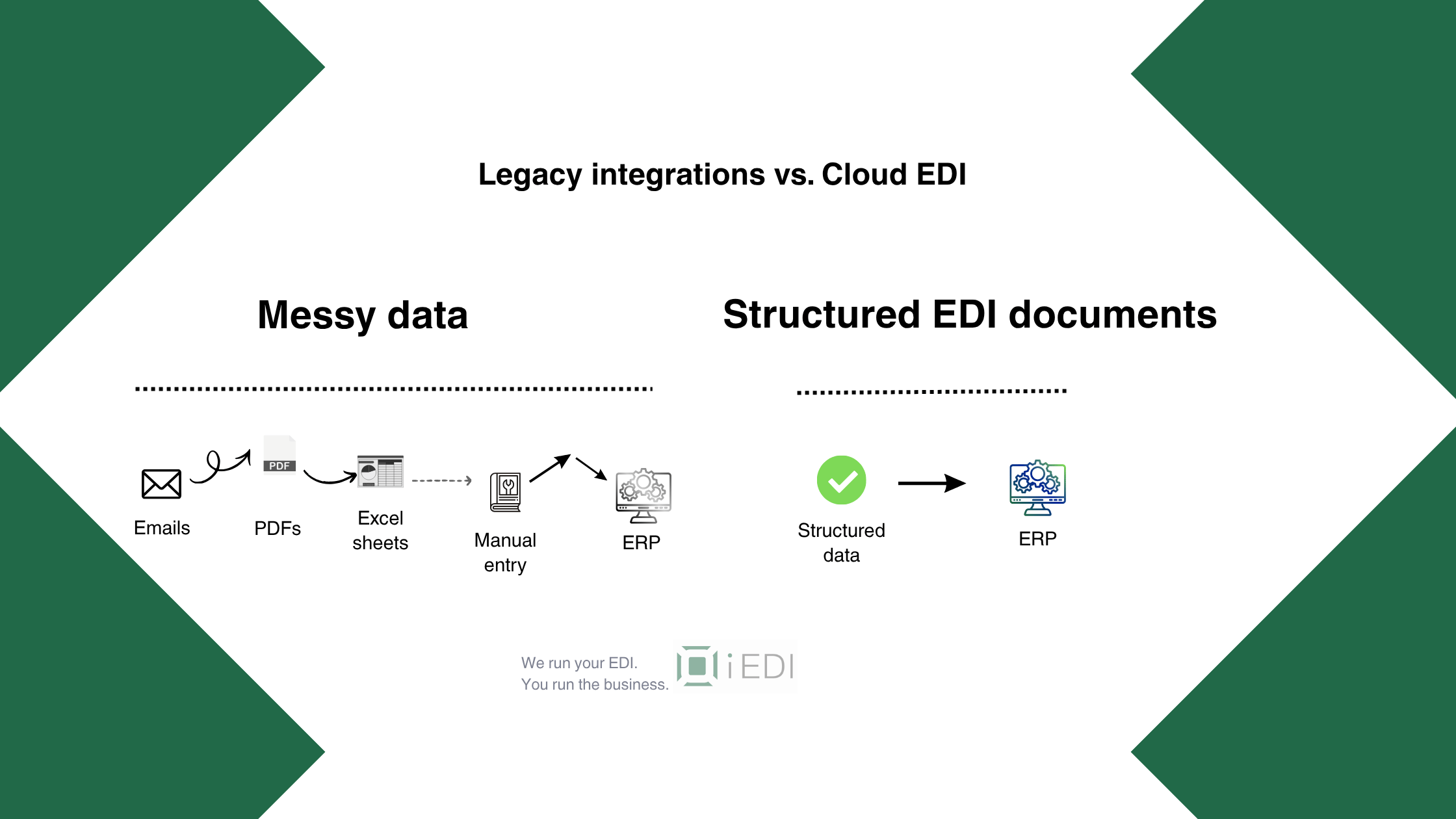
Cloud EDI platforms sit between your ERP system and your trading partners. When a partner sends a purchase order, the platform receives it, validates the data, converts it to your ERP's required format, and delivers it directly to your system. The reverse happens when you send invoices or shipping notices back.
Here's the typical flow: A retailer sends an EDI 850 purchase order. Your cloud EDI platform receives it, checks for errors, converts it to the format your ERP expects, and posts it automatically. Your warehouse sees the order immediately. No waiting for someone to manually process an email or PDF attachment.
This automation removes the delays that accumulate when orders pass through multiple hands. For mid-market operations processing hundreds or thousands of orders weekly, those delays add up to real money in overtime, expedited shipping costs, and chargebacks from missed SLAs.
The core document types include:
Each document type serves a specific function in the order-to-cash cycle. When these documents exchange automatically, your cash flow improves because invoices go out faster and discrepancies get caught earlier.
Not all cloud EDI solutions work the same way. Some give you a platform and expect you to manage mappings, partner onboarding, and troubleshooting yourself. Others—like managed EDI services—handle the operational work on your behalf.
For mid-market retailers without dedicated EDI specialists, managed services often make more sense. Your team focuses on selling products, not debugging failed transmissions. When a trading partner changes their requirements, the service provider updates the mappings. When something breaks, you call someone who fixes it.
iEDI operates as a managed EDI service with dedicated specialists handling onboarding, mappings, and daily operations. This model works well when you need to onboard partners quickly without growing your internal IT team.
Chargebacks from retailers hurt. They happen when your advanced shipping notice (ASN) doesn't match the physical shipment, when your invoice contains incorrect pricing, or when documents arrive late. Each chargeback costs money directly, and too many can damage your standing with trading partners.
Multichannel EDI reduces chargebacks by validating documents before they leave your system. The platform checks that required fields are populated, that item numbers match what the partner expects, and that pricing aligns with agreed terms. Errors get flagged before transmission, not after the retailer's system rejects your invoice.
This validation layer catches the kind of mistakes that happen when data moves between systems—typos, missing fields, format mismatches. Catching these issues early saves you from the operational scramble of fixing rejected documents under deadline pressure.
Traditional EDI providers charge per document, per kilocharacter, or per transaction. These fees seem small individually, but they add up quickly when you're processing thousands of orders monthly across multiple channels. Your EDI costs become unpredictable, and they grow precisely when your business grows—the opposite of economies of scale.
Flat-rate pricing models eliminate this problem. You pay a predictable monthly amount regardless of how many documents you send or receive. This makes budgeting easier and removes the disincentive to automate additional partners or channels.
iEDI uses flat-rate pricing with no per-transaction, per-document, or per-message charges. This approach means your EDI costs stay stable even as your order volume increases across channels.
Moving to multichannel EDI doesn't require replacing your ERP or overhauling your operations. Modern cloud platforms integrate with your existing systems through standard connectors and APIs. The typical implementation involves:
The timeline depends on how many partners you need to connect and how complex their requirements are. Some partners go live in days. Others with custom requirements take longer. The key is having clear visibility into where each partner stands in the onboarding process.
It's a system that exchanges electronic business documents—orders, invoices, shipping notices—across all your sales channels through a single platform. Instead of managing separate connections for each retailer or marketplace, you route everything through one unified system that handles format conversion automatically.
EDI automates the flow of purchase orders directly into your ERP system without manual data entry. When a retailer sends an order, your system receives it instantly in the correct format. iEDI's cloud platform converts documents automatically, so orders reach your warehouse faster with fewer errors.
Retailers commonly require EDIFACT in Europe, ANSI X12 in North America, and various XML formats globally. Many also have custom specifications. A managed EDI service like iEDI handles these variations by maintaining partner-specific mappings so you don't need to manage each format yourself.
Onboarding timelines vary based on partner complexity. Simple connections with standard formats can go live in days. Partners with custom requirements or extensive testing needs may take a few weeks. iEDI's dedicated team manages the onboarding process, keeping implementation timelines as short as possible.
Cloud EDI runs on hosted infrastructure, eliminating the need for your own servers and IT maintenance. On-premise EDI requires hardware, software licenses, and in-house expertise. Cloud solutions typically offer faster implementation, automatic updates, and scalability without capital investment.
EDI reduces chargebacks by validating documents before transmission. The system checks that ASN data matches shipment details, that invoices contain correct pricing, and that all required fields are populated. iEDI catches errors before they reach your trading partners, preventing the rejections that lead to chargeback fees.
.png?width=2240&height=1260&name=Greeces%20e-invoicing%20deadline%20is%20closer%20than%20you%20think%20-%20blog%20post%20(1).png)