New Zealand isn't introducing a general B2B e-invoicing mandate.
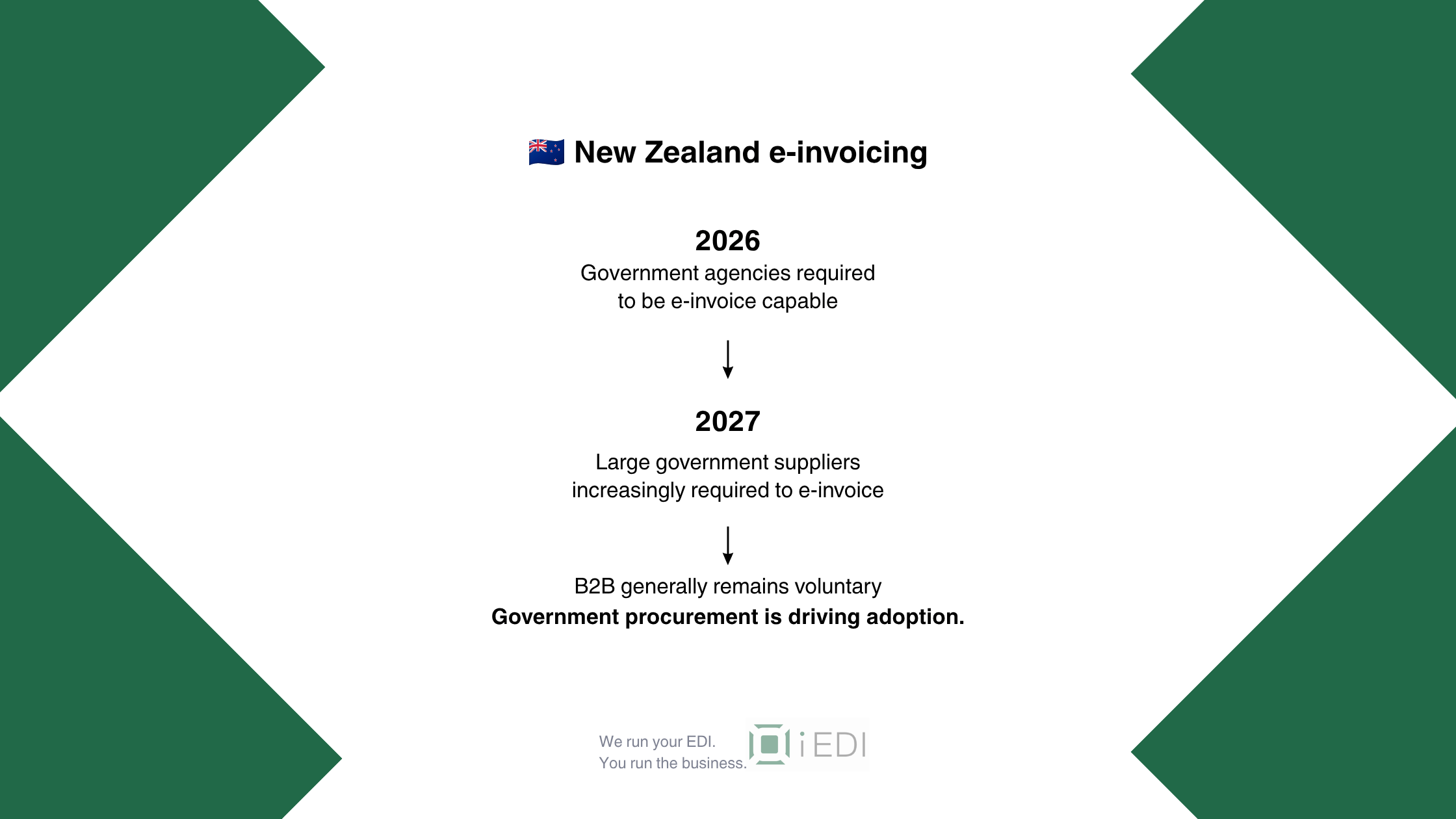
But from 1 January 2027, e-invoicing will become increasingly difficult for some businesses to treat as purely voluntary.
That's because government agencies covered by New Zealand's Government Procurement Rules must begin requiring their large suppliers to send eInvoices.
It is an interesting next step in New Zealand's approach to e-invoicing: rather than imposing a mandate across the entire private sector, the government is using procurement to encourage structured invoicing through Peppol.
First the government. Then its suppliers.
New Zealand has already established Peppol as its national framework for e-invoicing, with the Ministry of Business, Innovation and Employment (MBIE) acting as the country's Peppol Authority.
The public sector has been an important part of driving adoption.
Since 1 January 2026, government agencies within scope of the Procurement Rules have been required to have e-invoicing capability when they exceed specified invoice-volume thresholds. Government rules also link e-invoicing to faster payment: agencies are expected to pay supplier eInvoices within five business days.
From January 2027, the focus expands further along the supply chain.
Government agencies must require large suppliers to submit eInvoices. A large supplier is generally defined as an entity whose total annual revenue, including subsidiaries, exceeds NZD 33 million in each of the two preceding accounting periods.
But there's an important detail behind that date.
1 January isn't a switch being flipped
It would be easy to describe 1 January 2027 as New Zealand's next e-invoicing deadline.
Technically, it is.
But that doesn't mean every large supplier to the New Zealand government suddenly needs to send every invoice electronically from that morning.
The requirement isn't being applied retrospectively to all existing contracts.
Instead, government agencies are expected to incorporate e-invoicing into their procurement and contract-management processes over time. Businesses can therefore expect the requirement to appear when contracts are established, renewed, retendered or significantly changed.
That makes New Zealand's rollout less of a big bang and more of a gradual change in how doing business with government works.
For a large supplier, the question increasingly becomes not simply “Is e-invoicing mandatory in New Zealand?”, but “Will our next government contract require it?”
The same connection can take you beyond government
There's another interesting aspect to New Zealand's model.
Once a business has established Peppol e-invoicing capability to work with a government customer, that capability isn't limited to government transactions.
The same infrastructure can also be used to exchange structured invoices with other Peppol-enabled trading partners. New Zealand's own government guidance explicitly points to this wider opportunity for suppliers.
And adoption is growing. New Zealand's latest government figures show that monthly eInvoice volumes reached 75,752 in July 2026, up 12% from June, while the number of active monthly users reached 13,379.
So the 2027 requirement isn't occurring in isolation. It is another step in an e-invoicing ecosystem that is already developing.
Australia and New Zealand are taking a shared approach
For businesses operating across the region, there is also a bigger picture.
Australia and New Zealand have aligned their approach around Peppol, with specifications designed to support interoperability across both markets.
That makes the two countries interesting to consider together.
Australia currently has no general B2B mandate, but already has national Peppol infrastructure.
New Zealand also keeps general B2B e-invoicing voluntary, but is going one step further by using government procurement to bring more large businesses onto the network.
Neither country is following the kind of broad domestic B2B mandate we're seeing elsewhere.
But neither is standing still.
Voluntary B2B doesn't mean nothing is changing
New Zealand is another reminder of why the simple question “Is e-invoicing mandatory?” doesn't always tell the whole story.
For most domestic B2B transactions, the answer remains no.
For a large business supplying government, however, Peppol e-invoicing is set to become an increasingly normal part of procurement from 2027 onwards.
And once that infrastructure is in place, it can be used with other trading partners too.
At iEDI, we support e-invoicing in New Zealand through our Peppol connectivity. We can connect existing ERP and business systems to the network and handle the transformation and exchange of structured invoice data.
New Zealand may not have a general B2B mandate. But for businesses selling to government, 2027 is still a year worth preparing for.