FEATURED
GETTING STARTED

If you've ever researched EDI solutions, you've probably encountered terms such as VAN, AS2, API, and Peppol.
They often appear in the same conversations, sometimes even in comparisons that suggest businesses need to choose between them.
Should you use AS2 or a VAN? Is an API better than traditional EDI? And where does Peppol fit into the picture?
The difficulty is that these aren't four different solutions to exactly the same problem.
They describe different parts of how businesses exchange information electronically. Some concern how information travels between systems. Others concern the infrastructure, rules, or services that make that exchange possible.
Understanding those differences is useful when evaluating EDI providers, connecting with new trading partners, or preparing for electronic invoicing requirements.
But you don't need to understand every technical detail to make sense of them.
The best place to start is with a simple question: What problem is each one designed to solve?
Electronic Data Interchange (EDI) allows businesses to exchange structured information between their systems.
That information might represent a purchase order, an invoice, a shipping notice, or another business document.
For the exchange to work, the receiving system needs to understand the data. The businesses also need an agreed way of transporting it, identifying the parties involved, and handling the relevant technical and business requirements.
Those are related challenges, but they aren't identical.
A business might use EDIFACT to structure a purchase order, AS2 to transport it, and an EDI provider to translate the information into the format expected by its ERP.
Another business might exchange a structured invoice through the Peppol network using a service provider that handles the required communication and document specifications.
Both are examples of electronic business document exchange.
The underlying technologies and arrangements are different, but the objective is similar: enabling information to move between organisations without repeatedly being entered manually.
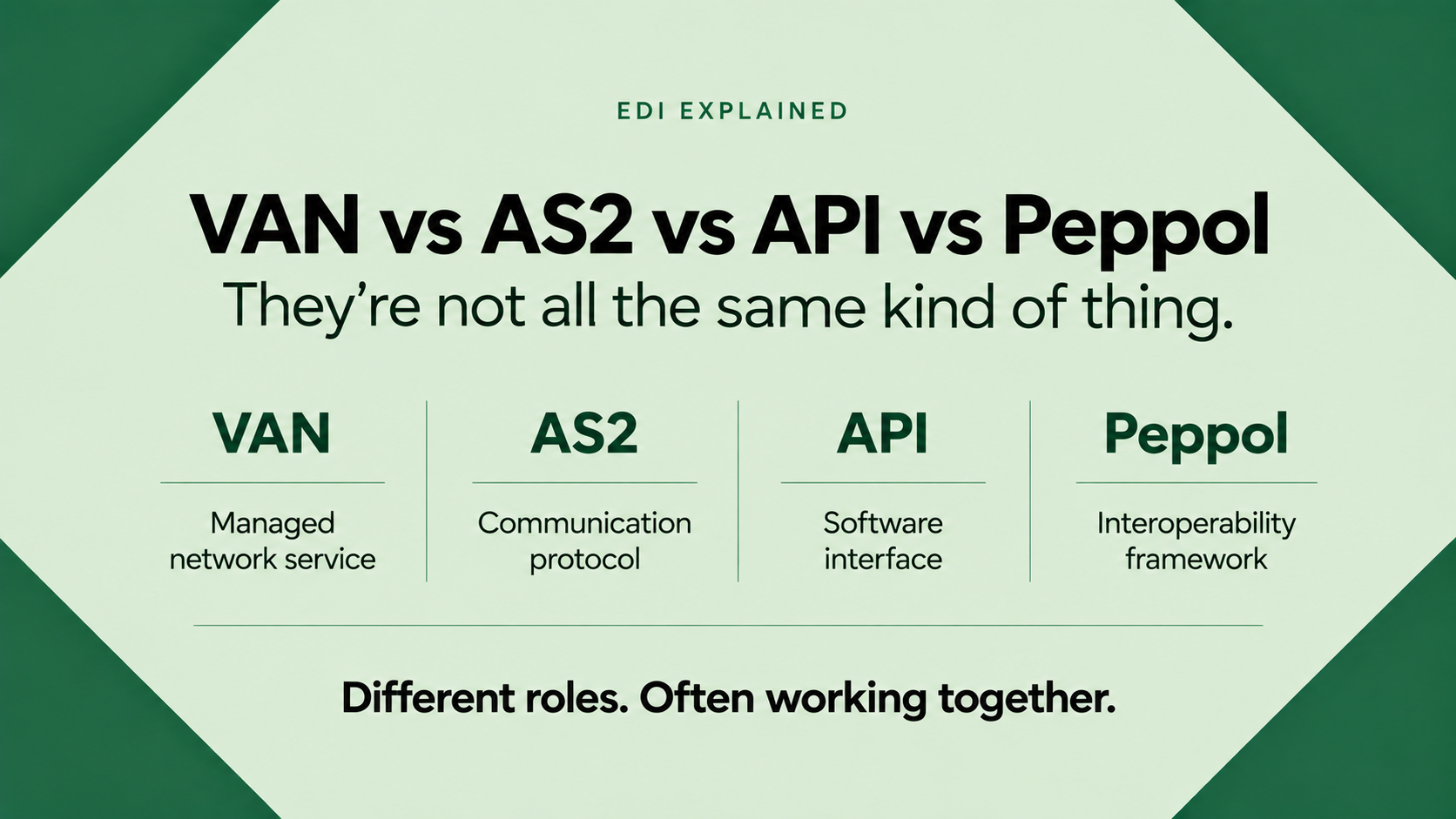
This distinction is important because VAN, AS2, API, and Peppol operate at different levels of that process.
VAN stands for Value-Added Network.
In traditional EDI environments, a VAN acts as an intermediary that helps businesses exchange electronic documents.
Instead of establishing and managing a direct communication connection with every trading partner, businesses can use a VAN provider to facilitate the exchange.
The provider may offer services such as message routing, secure transmission, mailbox functionality, tracking, and other capabilities, depending on the solution.
Imagine a supplier exchanging documents with dozens of retailers.
Each retailer may have different communication requirements. Managing every relationship individually can create additional technical and administrative work.
A VAN can help simplify that environment by providing a managed service for exchanging documents between participants.
The main attraction is therefore not simply the network itself. It's the ability to outsource some of the complexity involved in connecting and communicating with multiple trading partners.
Of course, the capabilities, pricing models, and level of interoperability vary between providers.
Using a VAN also doesn't automatically eliminate the need to handle different document formats or customer-specific requirements. Those differences still need to be managed somewhere in the integration process.
But for businesses with complex trading partner networks, a managed EDI service can be an effective way to reduce the burden of maintaining individual communication arrangements.
AS2 stands for Applicability Statement 2.
Unlike a VAN, AS2 isn't a managed network service. It's a communication protocol used to exchange data securely over the internet.
In an EDI context, AS2 is commonly used to transmit structured business documents between trading partners.
It supports security mechanisms such as encryption and digital signatures, and it can provide message disposition notifications (MDNs) that acknowledge message processing at the AS2 protocol level.
That makes it useful for organisations that need a secure, established method of exchanging electronic documents.
AS2 is often associated with direct connections between businesses.
For example, a large retailer may require suppliers to exchange EDI documents through AS2. The supplier then needs a compatible AS2 setup, either internally or through an EDI service provider.
But there's an important distinction between successfully transmitting a message and successfully processing the underlying business transaction.
An AS2 acknowledgement can provide evidence about the protocol-level handling of a message. It doesn't necessarily confirm that the receiving ERP has accepted the purchase order or created the corresponding business document.
AS2 handles the communication layer.
The interpretation and processing of the information remain separate responsibilities.
And while AS2 can be used for direct partner-to-partner communication, it can also be offered as part of a managed EDI service.
That is one reason why treating AS2 and VAN as mutually exclusive choices can be misleading.
API stands for Application Programming Interface.
An API defines how software applications can interact with one another, often by exchanging data or requesting specific operations.
APIs are widely used across modern business systems, including ERP platforms, e-commerce applications, warehouse management systems, and cloud services.
In an EDI environment, APIs can be useful for connecting internal applications with an integration platform or exchanging information with external partners.
For example, an EDI provider might receive an electronic purchase order from a retailer and then use an ERP API to create the corresponding sales order in the supplier's system.
Alternatively, a trading partner may offer an API through which order or inventory information can be exchanged directly.
APIs can support timely data exchange and close integration with business applications, but they don't automatically provide a shared business document standard.
Two APIs may expose completely different data structures and require different authentication methods, fields, and processing rules.
That means API integration can still involve mapping, validation, and customer-specific development.
This is also why the statement “We're replacing EDI with APIs” deserves a closer look.
In some cases, businesses are replacing a particular communication method or integration architecture with API-based exchange.
But the underlying requirement – exchanging structured business information between systems – hasn't disappeared.
In fact, APIs and EDI often work together.
The EDI layer can manage external trading partner requirements while APIs connect the exchanged information to internal business applications.
Peppol is different again.
Rather than being simply a communication protocol or a general-purpose API, Peppol provides an interoperability framework for exchanging electronic business documents.
It combines technical specifications, document standards, participant identification, and governance rules that allow organisations to communicate through a network of compliant service providers.
Peppol is particularly well known for electronic invoicing, although its supported business processes extend beyond invoices.
One of its defining features is the four-corner model.
Instead of every supplier needing a direct technical connection with every buyer, each organisation can connect through a Peppol service provider, commonly called an Access Point.
Those service providers exchange documents according to the applicable Peppol specifications.
This makes it possible for organisations using different service providers to exchange supported documents without establishing a completely separate bilateral integration for every relationship.
Peppol also defines requirements for document structures and business rules, helping establish a common understanding of the information being exchanged.
The Peppol network commonly uses AS4 as its transport protocol.
That doesn't make AS4 and Peppol the same thing. AS4 is part of the technical communication infrastructure, while Peppol provides the broader framework in which that communication takes place.
Peppol has become increasingly important as governments and businesses adopt structured electronic invoicing, although individual countries may impose additional requirements or use different national models.
And joining the Peppol network doesn't necessarily mean every trading partner or document type can automatically be exchanged. The relevant participants, document specifications, and business processes still need to be supported.
This is where the comparison becomes more interesting.
Because the answer may not be one of the four.
A business could use a managed EDI provider that supports AS2 connections with certain customers, exchanges documents through Peppol with others, and uses APIs to integrate the information with its ERP.
In that environment, the technologies aren't competing. They're performing different roles.
A VAN or managed EDI service may help coordinate communication with multiple trading partners.
AS2 may be the required communication protocol for a particular customer.
APIs may provide the connection between the integration environment and internal business applications.
Peppol may provide the interoperable framework needed to exchange structured invoices or other supported documents with participating organisations.
The right combination depends on the requirements of your business and its trading partners.
If a major customer requires AS2, your solution needs to accommodate that requirement.
If you're preparing for e-invoicing in a country that uses Peppol, your provider needs to support the applicable framework and national obligations.
If your ERP offers suitable APIs, those may be an effective way to connect the internal system with your EDI environment.
The most important question isn't which technology sounds the most modern.
It's whether the overall solution can exchange the information your business needs, with the partners you work with, in a reliable and manageable way.
It's easy for EDI discussions to become dominated by acronyms.
But the people responsible for orders, deliveries, and invoices generally care about something much more practical.
Did the order arrive correctly?
Can the warehouse process the shipment?
Did the customer receive the invoice?
And will someone know if something goes wrong?
VANs, AS2, APIs, and Peppol can all contribute to answering those questions, but in different ways.
Understanding their roles helps businesses ask better questions when evaluating an integration solution.
It also helps prevent unnecessary complexity. A company shouldn't need to manage several incompatible technologies internally simply because its customers and suppliers have different requirements.
At iEDI, we help businesses connect their ERP systems with trading partners across different document formats, communication methods and electronic invoicing frameworks.
Because the goal isn't to choose the most impressive acronym.
It's to make sure the right information reaches the right system – in a format it can actually use.