The UAE’s mandatory e-invoicing rollout may officially begin in 2027. But for many businesses, the first important deadline arrives much sooner.
Businesses with annual revenue of AED 50 million or more must appoint an Accredited Service Provider (ASP) by 30 October 2026. From 1 January 2027, these businesses must implement the UAE Electronic Invoicing System.
Smaller businesses follow from July 2027, while government entities enter the mandatory system from October.
So, for businesses affected by the first phase, e-invoicing is no longer a project for next year. It is a project for now.
More than another e-invoicing mandate
What makes the UAE particularly interesting is not only the timeline. It is the infrastructure being built behind it.
The UAE has chosen a decentralised model based on Peppol, the international network and framework already used for electronic document exchange in a growing number of countries.
But the UAE adds something to the familiar Peppol setup.
In a conventional four-corner model, an invoice moves from the supplier through its service provider to the buyer’s service provider and ultimately to the buyer.
The UAE introduces a fifth corner: the government.
While structured invoice data is exchanged between businesses through their Accredited Service Providers, required tax data is also reported electronically to the Federal Tax Authority.
This allows the same infrastructure to support two objectives at once: efficient electronic document exchange between businesses and tax reporting to the authorities.
A PDF will not be enough
This distinction is important for businesses preparing for the mandate.
Sending a PDF invoice by email may be digital, but under the UAE framework it is not an e-invoice.
An e-invoice must contain structured data that can be processed electronically. That means businesses need to consider how invoice data is generated by their ERP or accounting system, how it is converted into the required structure, and how it reaches the appropriate Accredited Service Provider.
For larger organisations, that can involve considerably more than switching on a new invoice format.
Existing integrations, customer and supplier data, validation requirements, mappings and internal processes may all need to be reviewed and tested.
The first deadline is about choosing your connection
The requirement to appoint an Accredited Service Provider by 30 October is therefore significant.
The ASP becomes an important part of the connection between a company’s existing business systems and the UAE e-invoicing infrastructure.
For businesses with several ERP systems, high invoice volumes or operations across multiple countries, the wider question is also worth considering: how does the UAE fit into the organisation’s existing document infrastructure?
Because the UAE may be one mandate, but it is unlikely to be the only one an international business has to prepare for.
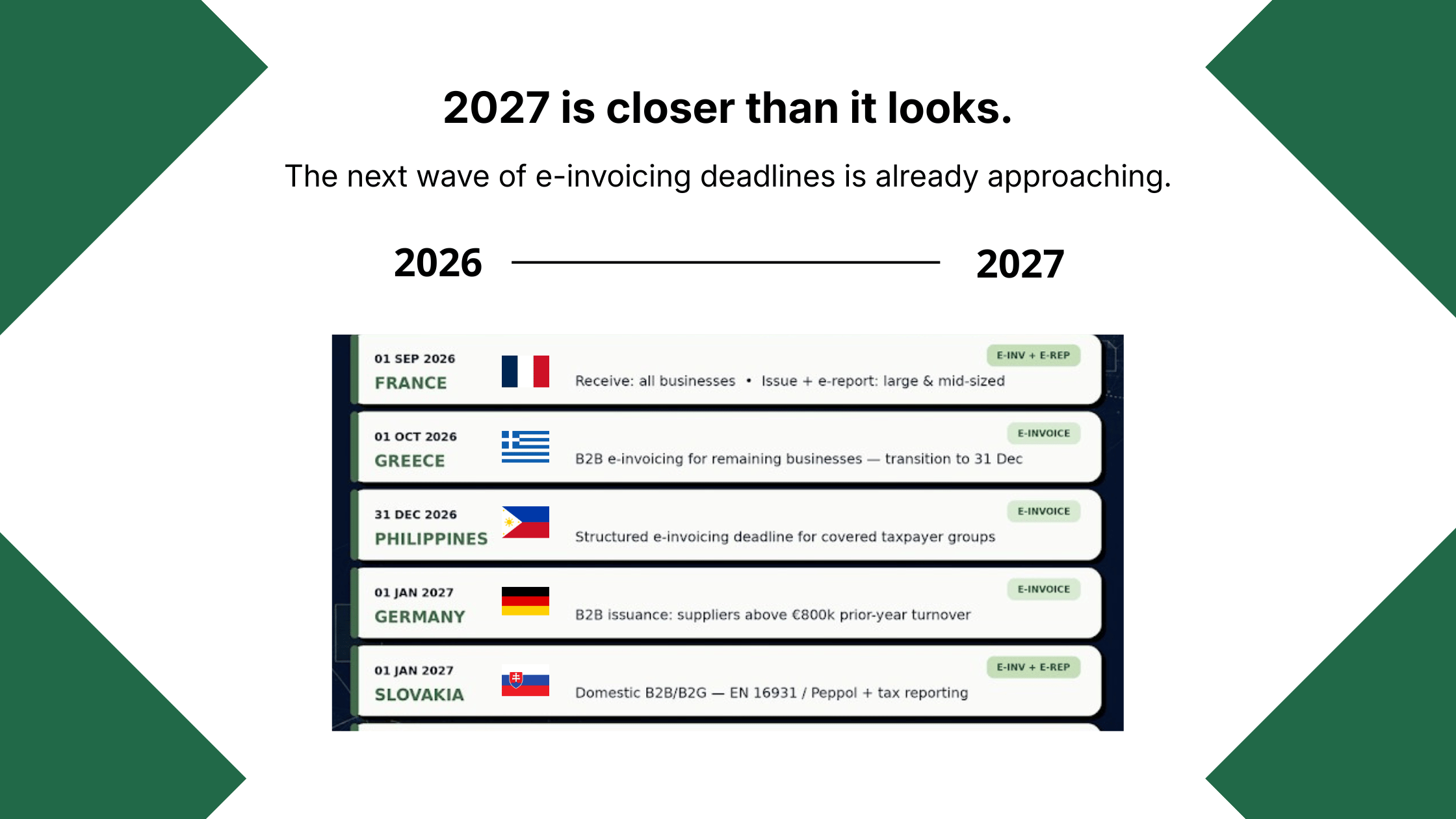
France, Belgium, Poland, Germany, Slovakia and many other markets are introducing or expanding structured e-invoicing requirements. Outside Europe, countries are developing their own approaches too.
The individual rules differ considerably. The underlying challenge is increasingly the same: getting structured business data from existing systems into the right network, platform or provider in the right format.
2027 starts in 2026
The UAE’s rollout is another good example of why businesses should not use the mandatory go-live date as the starting point for an e-invoicing project.
For businesses with annual revenue of AED 50 million or more, mandatory e-invoicing starts on 1 January 2027.
But the ASP must be appointed by 30 October 2026.
And before a solution goes live, there is still integration, mapping, validation, testing and onboarding to consider.
In other words, the first UAE deadline is already approaching.
At iEDI, we help businesses exchange, convert and validate structured business documents across EDI standards, Peppol and country-specific e-invoicing frameworks. Support for UAE e-invoicing is coming soon.
If your business will be affected by the UAE mandate, now is the time to start looking at how your existing systems and document flows will need to connect.



.png?width=2240&height=1260&name=Greeces%20e-invoicing%20deadline%20is%20closer%20than%20you%20think%20-%20blog%20post%20(1).png)